Retention: the phase that protects your result
Retention is the phase that follows the removal of aligners or braces: a thin wire bonded behind the teeth, a removable retainer, or both, hold the teeth in their new position. Without it, teeth naturally tend to drift back towards where they started, which is called relapse. Current orthodontic guidance therefore treats retention as an integral part of treatment, not an optional extra.
Many patients see it as a formality after months of effort. Yet this is when the long-term stability of the smile is decided. A well-chosen retainer that is worn properly and checked regularly is generally the best way to keep the alignment you have achieved. Whether you were treated with clear aligners or with fixed braces, the principle is the same.
Why teeth want to move back
A tooth is not fused to the bone: it is suspended in its socket by a network of fibres, the periodontal ligament. During treatment, these fibres and the surrounding bone remodel to allow the tooth to move. Once the tooth is in place, that remodelling is not finished. The gum fibres, especially those linking neighbouring teeth above the bone, reorganise slowly and keep a kind of "memory" that pulls the tooth towards its original position.
Other forces act throughout life:
- pressure from the lips, cheeks and tongue;
- habits such as an atypical swallow, tongue thrusting or nail biting;
- clenching or grinding;
- age-related change: even without orthodontics, the lower front teeth tend to crowd gradually in adulthood.
Wisdom teeth are often blamed for this late crowding, but they are not established as the main cause. Removing them is therefore not, on its own, a retention strategy.
The bonded retainer
A bonded, or fixed, retainer is a fine metal wire attached to the inner surface of the teeth, usually from canine to canine, on the lower jaw and sometimes the upper. It is held by small dots of composite and cannot be seen from the front.
Its advantages:
- it works around the clock, without relying on your discipline;
- it is particularly useful when the risk of relapse is high, for example after closing a gap between the front teeth or correcting badly rotated teeth.
Its limits:
- flossing becomes harder: you need a floss threader, special floss or suitable interdental brushes;
- tartar readily builds up behind the lower front teeth, which is why regular scaling matters;
- a bonding point can come loose without you noticing, and the tooth concerned may then move;
- more rarely, a slightly distorted wire can apply an unintended force and shift a tooth. Regular checks pick up these situations early.
The removable retainer
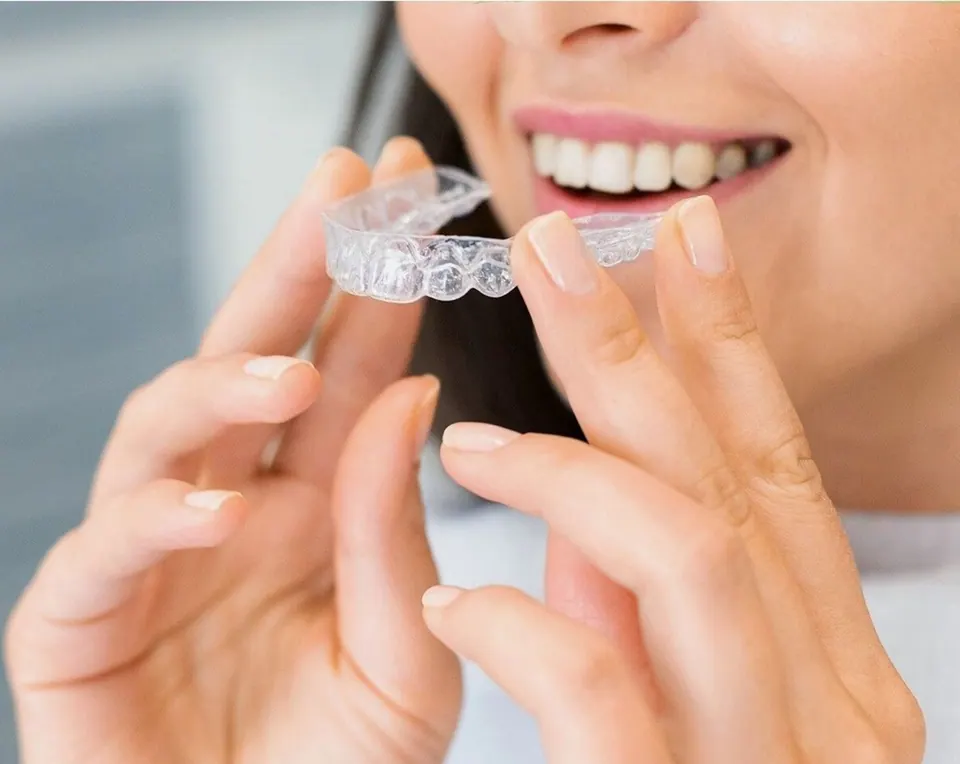
A removable retainer is a thin, clear plate vacuum-formed over a model of your teeth. It looks like an aligner but moves nothing: it holds. There are also more traditional removable appliances, with an acrylic part and a wire visible across the front teeth, used less often today but still indicated in some cases.
Its advantages:
- hygiene stays simple, as you take it out to brush and floss;
- it holds every tooth in the arch, including the molars;
- it may protect the enamel in people who clench at night, although it does not replace a dedicated night guard when one is needed.
Its limits:
- it only works if you wear it;
- it wears, cracks or distorts over time and needs replacing;
- it is easily lost, often left wrapped in a napkin at a restaurant.
In many cases the dentist combines a bonded wire with a night-time retainer for both security and overall support.
How long should you wear a retainer?
This is the most common question, and the honest answer often surprises people: the current trend is towards long-term retention, frequently with no end date. Teeth remain mobile throughout life, and no time frame guarantees they will never move again.
In practice, the most common pattern is as follows, adapted to each case:
- an initial phase of intensive wear, day and night, as instructed by your dentist;
- then night-time wear, which becomes routine;
- for a bonded wire, keeping it as long as it remains in good condition and hygiene is satisfactory.
A simple test tells you a lot: if your retainer feels very tight when you put it back after forgetting it for a night or two, your teeth have already started to move. Wear it more consistently and let your dentist know. If it no longer fits, do not force it: book an appointment soon.
Caring for your retainer every day
A clean retainer is more comfortable and lasts longer. A few habits are enough:
- removable retainer: rinse it in the morning and brush it gently in cold or lukewarm water with a soft brush and mild soap, not abrasive toothpaste;
- avoid hot water, which can warp it, and do not leave it in the sun or in a car;
- always keep it in its case, never in a tissue;
- do not drink sugary or coloured drinks while wearing it;
- bonded wire: every day, pass suitable floss or interdental brushes under the wire, and check with your tongue that no point has come loose.
After aligner treatment, it is worth keeping your last set of aligners: they can help for a few days if you lose your retainer, without replacing the one prescribed. When your impression was taken with an intraoral scanner, the digital file can make it easier to produce a new retainer, provided your teeth have not moved in the meantime.
Retainer follow-up in Agdal
A retainer is not fitted to be forgotten. Regular check-ups make it possible to examine the bonding points, the condition of the removable retainer, the health of the gums and the stability of the alignment. If you were treated elsewhere, abroad or in another city, and now live in Rabat, this follow-up can easily be taken over.
At German Dental Clinic in Agdal, the dentist examines your retainer, adjusts or replaces it if needed, and explains the wear schedule suited to your situation. If you are still choosing between treatment techniques, our article on aligners or metal braces sets out the differences. For a check-up or a retainer that has come loose, you can book an appointment.
Frequently asked questions
What should I do if my bonded retainer has come loose?
Do not pull on it or try to glue it back yourself. If the wire is rubbing or cutting your tongue, you can cover it temporarily with a little orthodontic wax. Book an appointment soon: while a point is loose, that tooth is no longer held and can shift within a few weeks.
I stopped wearing my retainer months ago. Is it serious?
Not necessarily, but do not force a retainer that no longer fits. If it only goes in with strong pressure, your teeth have moved slightly. An examination will show whether simply wearing it again is enough, whether you need a new retainer or, if relapse is marked, a short course of retreatment.
Does a fixed retainer damage teeth or gums?
The wire itself does not damage the teeth. The risk comes mainly from plaque and tartar building up around it, which can irritate the gum. With suitable daily cleaning and regular professional scaling, a fixed retainer is generally well tolerated over long periods.
Can the bonded wire be removed one day?
Yes, it can, but you should know that teeth may move again once it is gone. When the wire is removed, for example for hygiene reasons, the dentist usually suggests a night-time removable retainer to take over. The decision is made together, with that risk in mind.
Are clear retainers the same as aligners?
They look alike, but their roles differ. An aligner is designed to move teeth gradually, while a retainer is designed to keep them where they are. Retainers are often slightly thicker and sturdier, because they are meant to be worn for a long time, mainly at night.
The information on this page is general. Only a consultation allows a diagnosis and a suitable treatment plan.