Screw-retained or cemented: the short answer
An implant crown can be fixed in two ways. Screw-retained, it is held by a screw that passes through the crown and tightens into the implant; the small access hole is then closed with tooth-coloured composite. Cemented, it is bonded with cement onto an abutment that is itself screwed into the implant, like a conventional crown on a tooth. The screw-retained version has the advantage of being retrievable and avoids any excess cement under the gum; the cemented version completely hides the screw access and copes better with certain implant angles.
Neither is good or bad in itself. The choice depends on the implant position, the area of the mouth, the space available and how easy future maintenance will be.
Understanding this difference helps you follow your dentist's reasoning and know what to watch for in the years ahead.
Understanding the parts: implant, abutment, crown
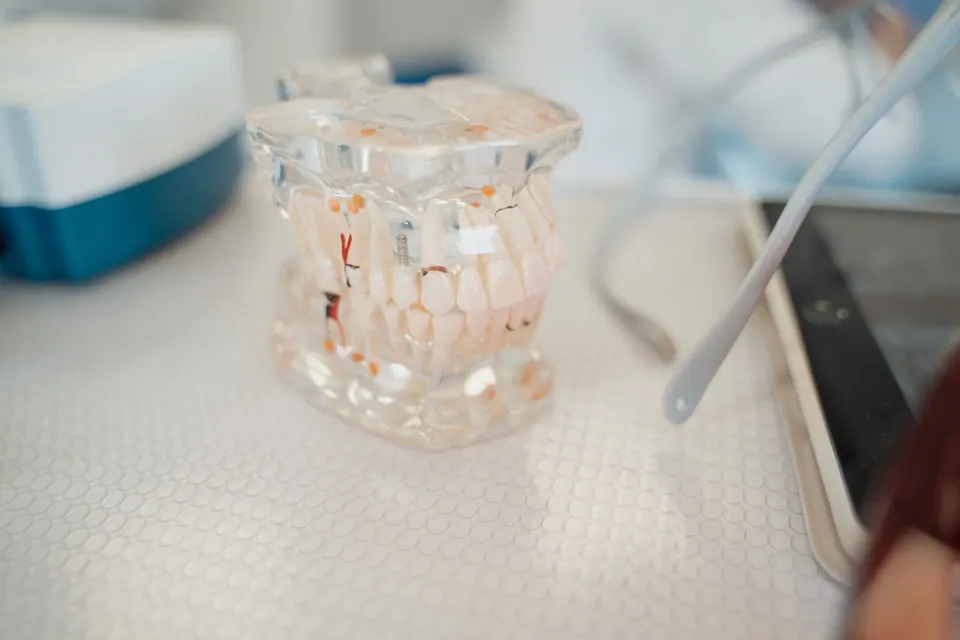
A tooth on an implant is not a single piece but an assembly:
- the implant, the titanium or zirconia screw placed in the bone, which replaces the root;
- the abutment, the intermediate part that passes through the gum and connects the implant to the crown;
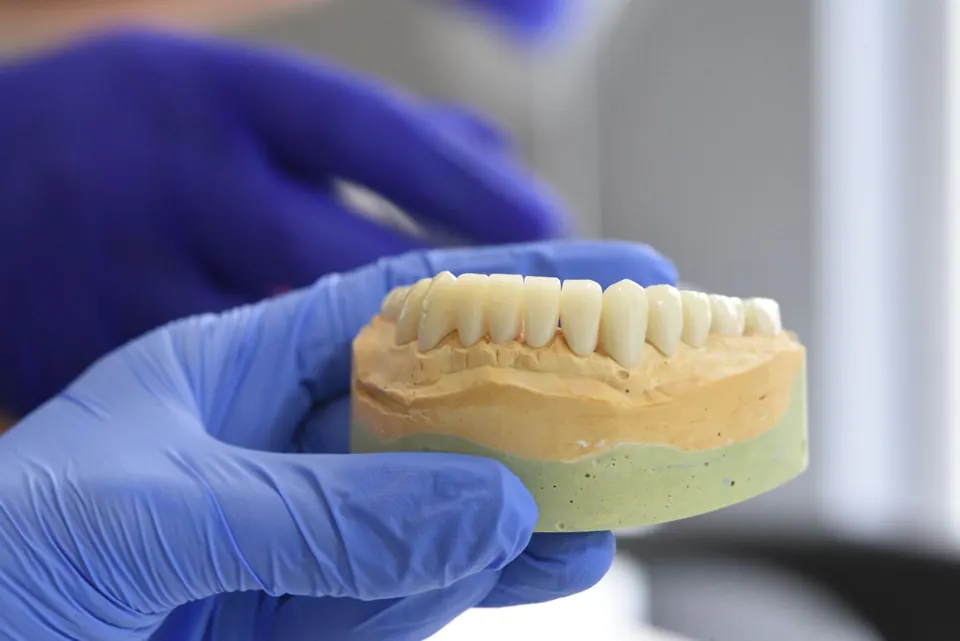
- the crown, the visible part, made of ceramic or zirconia.
In a screw-retained crown, the abutment and crown are often joined in the laboratory into a single piece, for example a zirconia crown bonded to a titanium base, and the whole unit is screwed directly into the implant. In a cemented crown, the abutment is first screwed into the implant, then the crown is cemented onto it in the mouth.
These parts are designed from an impression that records the exact position of the implant. With an intraoral scanner, a small locating part (scan body) is temporarily screwed onto the implant, transferring its position to the design software without impression paste.
There is always a screw connecting the abutment to the implant, so the real question is not "screw or no screw" but whether the crown itself is screwed or cemented.
The screw-retained crown: advantages and constraints
Screw retention is now widely preferred when the implant position allows it, and several international consensus conferences, including those of the ITI, have highlighted its value. Its advantages:
- retrievable: the dentist can remove the crown to repair it, check the implant or clean the area, then screw it back without destroying it;
- no cement under the gum, so no risk of forgotten excess cement;
- useful when vertical space is limited, as it does not need a minimum abutment height to stay in place;
- particularly valuable for bridges on several implants, which can be removed in one piece.
Its constraints:
- the access hole must come out on a discreet surface of the tooth: the palatal side of an incisor, the chewing surface of a molar. If the implant is too angled, the access may emerge on the visible face;
- the composite closing the hole can wear or stain and is easily redone;
- the ceramic is slightly thinner around the access channel, which is taken into account in the design.
Angled screw channel systems can, within certain limits, move the access exit to a more discreet area.
The cemented crown: advantages and the cement risk
In principle, a cemented crown resembles a crown placed on a natural tooth. Its advantages:
- no visible opening in the crown, giving an uninterrupted ceramic surface;
- the abutment can correct an unfavourable implant angle;
- a familiar technique suited to many situations.
Its main point of caution is the cement. During cementation, excess cement can squeeze out under the gum around the abutment. Unlike a natural tooth, an implant has no ligament to defend it, and residual cement left behind can sustain inflammation. Scientific literature has linked such residues to peri-implant mucositis and peri-implantitis, sometimes years after placement.
Several precautions reduce this risk:
- a custom abutment whose margin follows the gum contour at a shallow depth, so the cement can be removed;
- a minimal amount of cement, sometimes with pre-cementation on a replica outside the mouth;
- meticulous cleaning and a check X-ray.
Another limitation: a cemented crown is harder to remove. If the abutment screw loosens or the ceramic fractures, the crown often has to be cut off.
Aesthetics, implant position and planning
The choice between screw and cement is really prepared before the implant is placed. So-called prosthetically driven planning starts from the desired final tooth, then places the implant where it will allow the best restoration. When indicated, guided surgery helps transfer this plan into the mouth precisely. A well-angled implant generally leaves the option of a screw-retained crown with a discreet access hole.
In the aesthetic zone, other factors come into play:
- gum thickness, which may let a titanium abutment show through; a zirconia abutment or suitable base may then be preferred;
- the emergence profile, meaning how the crown comes out of the gum, which determines a harmonious gum line;
- the shade and translucency of the crown material.
For back teeth, the issue is mainly functional: ceramic strength, contact with the opposing tooth and ease of cleaning. A dental crown on an implant in monolithic zirconia is often chosen for its strength in these areas.
Maintenance, screw loosening and follow-up
Whatever the fixing method, an implant crown needs the same hygiene as a natural tooth, and a little more attention:
- careful brushing where the crown meets the gum;
- daily interdental cleaning with suitable floss or interdental brushes;
- regular check-ups, with gentle probing and X-rays on the schedule proposed;
- protection with a night guard if you grind your teeth.
Screw loosening shows up as a crown that moves slightly or a small click when chewing. It is not serious in itself if dealt with promptly: with a screw-retained crown, it is usually enough to reopen the access and retighten the screw to the recommended torque. With a cemented crown, the procedure is more delicate. In all cases, do not leave a loose crown in place without advice, as repeated movement fatigues the components.
Bleeding, swelling or a bad taste around the dental implant are also reasons to be seen, since inflammation caught early is simpler to treat.
Questions to ask and assessment in Agdal
When your implant is being restored, these questions help you understand the proposed solution:
- Will my crown be screw-retained or cemented, and why in my case?
- Where will the screw access come out, and will it be visible?
- If it is cemented, how will excess cement be controlled?
- Which material is planned for the crown and the abutment?
- What happens if the screw loosens or the crown fractures?
At German Dental Clinic in Agdal, the implant position is planned with the future crown in mind. The impression can be taken with an intraoral scanner, and the design follows a digital workflow. The fixing method is explained and chosen according to your situation after examination. If you live in Rabat and have an implant awaiting its crown, or an existing implant crown that is causing problems, you can book an appointment for an opinion.
Frequently asked questions
Is the hole in a screw-retained crown visible?
It is placed, as far as possible, on a discreet surface: the palatal side for front teeth, the centre of the chewing surface for back teeth. It is closed with tooth-coloured composite. Close up, a small, slightly different area can sometimes be seen, but it is generally invisible when you talk and smile.
Is a screw-retained crown weaker than a cemented one?
Not in general. Both types of retention can give lasting results when the design is sound. The ceramic is slightly thinner around the access channel of a screw-retained crown, which the choice of material and the thickness of the restoration compensate for. Strength depends mainly on the material, the bite and chewing forces.
Can a cemented crown be replaced by a screw-retained one?
Sometimes, when the implant angle allows screw access through a discreet surface of the tooth. The old crown usually has to be removed, often by cutting it, and a new restoration made. This change is mainly discussed when there is a problem, such as cement-related inflammation or repeated loosening.
Is it normal for an implant crown to come loose?
It is not the usual course, but it can happen, particularly with heavy forces, tooth grinding or unevenly distributed contacts. Loosening dealt with promptly is generally simple to fix. The dentist also checks the bite and the condition of the components to limit the risk of recurrence.
Is cement under the gum really dangerous?
Excess cement left under the gum can sustain inflammation around the implant, sometimes without pain for a long time. It is a known risk, reduced by an abutment with a shallow margin, a minimal amount of cement and careful cleaning. Persistent bleeding around a cemented implant crown deserves a check.
The information on this page is general. Only a consultation allows a diagnosis and a suitable treatment plan.