
The short answer: two materials, two approaches
Composite veneers are built directly on the tooth in resin, often in a single visit, with little or no reshaping of the enamel. Porcelain (ceramic) veneers are custom-made (in a laboratory or by milling) and then bonded: they hold their colour and shine better, but usually need slightly more preparation and a higher initial budget.
Neither is "the best" in absolute terms. Composite works well for limited corrections, for younger patients, or for anyone who wants a reversible result. Porcelain tends to be the better fit when you want a lasting change across several teeth, a very stable shade or a finish that closely mimics natural enamel.
To choose wisely, it helps to understand how each material behaves in the mouth over the years, what weakens it and what upkeep it involves.
How composite veneers are made
Composite is a resin filled with mineral particles, the same family of materials used for tooth-coloured fillings. For a direct veneer, the dentist applies composite to the tooth layer by layer, combining more opaque shades (to mimic dentine) with more translucent ones (to mimic enamel), then sculpts, light-cures and polishes it.
A typical appointment:
- shade selection, ideally after any teeth whitening, because composite will not whiten afterwards;
- light cleaning and surface preparation, often without drilling the enamel;
- application of a bonding agent, then the layers are built up;
- shaping and careful polishing, which largely determines the final look.
When several teeth are treated, a silicone key made from a wax-up helps transfer the planned shapes to the mouth. Indirect composite veneers, made outside the mouth and then bonded, also exist but are less common. The result depends heavily on the clinician's hand and eye.
How porcelain veneers are made
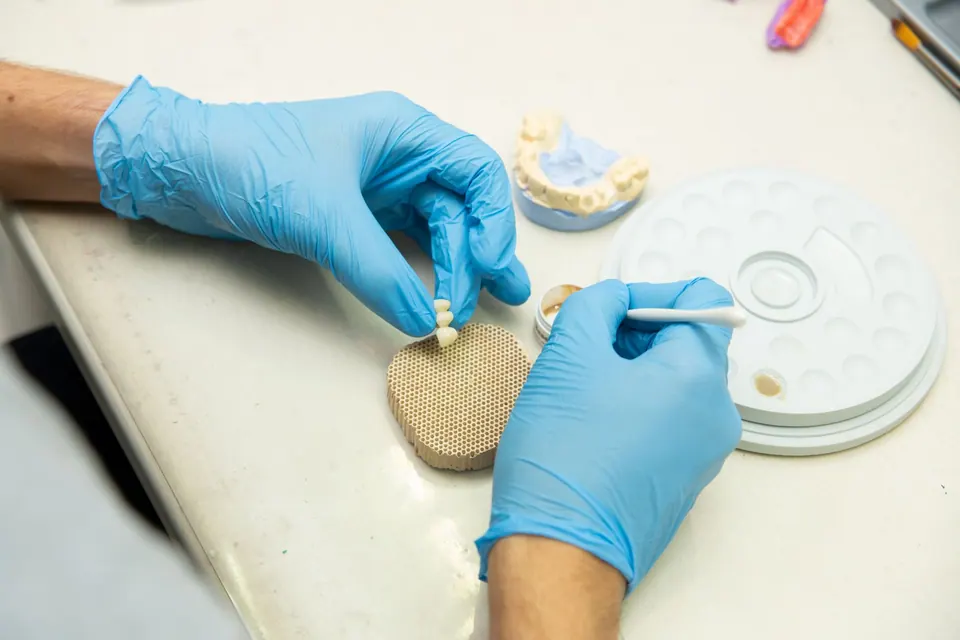
A porcelain veneer is a thin shell of ceramic bonded to the visible surface of the tooth. The most widely used materials are feldspathic ceramics, which are highly aesthetic, and lithium disilicate, which combines good strength with translucency. The choice between them depends on the tooth and the situation, as we explain in our article on e.max or zirconia.
The usual steps:
- smile analysis, photographs and often a trial mock-up to approve the design;
- enamel preparation, usually limited to a few tenths of a millimetre, and sometimes none at all in selected cases;
- an impression, either conventional or digital with an intraoral scanner;
- fabrication, then try-in and bonding with a strict adhesive protocol.
Once bonded, the porcelain becomes one unit with the enamel. It is this bond, more than the thickness of the material, that makes it strong. Our dental veneers page describes the full treatment journey.
Longevity, colour and repair
Over time is where the two materials differ most.
- Colour. Porcelain is very stable and does not stain with coffee, tea or tobacco. Composite is more porous and can dull and pick up surface stains, especially along the margins.
- Shine and wear. The glazed surface of porcelain stays smooth. Composite gradually loses its polish and wears more, so periodic re-polishing is usually needed.
- Chipping. Composite edges can chip, particularly in people who bite their nails or clench. Porcelain resists wear better but can fracture after a knock or under excessive force.
- Repair. This is composite's strong point: a small chip can often be repaired in one visit by adding material. A fractured porcelain veneer is difficult to repair and generally has to be remade.
Day to day, a few habits protect both types of veneer: a low-abrasion toothpaste, a soft brush, floss or interdental brushes along the edges, and giving up harmful habits such as opening packets with your teeth or chewing pens. At check-ups, the dentist checks that the margins are sealed, the gums are healthy and the edges are not wearing.
In both cases, longevity depends mainly on hygiene, habits and follow-up, not on any guaranteed lifespan.
Tooth preparation and reversibility
Many patients worry about having their teeth "filed down". The question deserves a nuanced answer.
Composite can often be placed without touching the enamel, which makes the treatment largely reversible: the material can be removed or modified later. That is a strong argument for a young adult or for someone who wants to try a change first.
With porcelain, preparation is now designed to be minimally invasive and, wherever possible, stays within the enamel, which gives the best bond. Some cases even allow no-prep veneers, provided the teeth are suitable (small teeth, teeth set slightly back, gaps to close). On the other hand, teeth that already stand forward or are heavily discoloured often still need light preparation, to avoid overly thick veneers that would look bulky and trap plaque at the gum line.
One rule still holds: a tooth prepared for porcelain will not return to its original state. The decision should therefore be considered carefully, based on a simulation you have approved.
The cost logic, without figures
Cost is not only what you pay on the day the veneers are fitted. It makes more sense to think about the whole life cycle of the restoration.
Composite involves fewer steps and no external fabrication, so its initial cost is generally lower. However, you should expect re-polishing, touch-ups and, eventually, more frequent replacement. Porcelain is a larger initial investment (design, fabrication and try-in stages), but in principle it needs fewer maintenance visits.
Some patients choose composite as a first step, with the option of moving to porcelain later once they are sure of the shape and shade they want. The detailed quote provided after the consultation lets you compare the options properly, taking into account how many teeth are involved.
Ultimately, the most expensive veneer is one that was not the right indication and has to be redone.
Who is a good candidate, and how to choose in Rabat
Before any veneer, the mouth must be healthy: decay treated, gums free of inflammation, and no major misalignment that clear aligners would correct better. Bruxism (clenching or grinding) does not necessarily rule veneers out, but it calls for precautions and often a night guard. If a tooth is heavily broken down, a crown may be more appropriate: see our comparison of veneers or crowns.
Useful questions to ask your dentist:
- which material suits my teeth, and why?
- does the enamel need preparing, and by how much?
- can I see a simulation before deciding?
- what maintenance and check-ups should I plan for?
At German Dental Clinic in Agdal, the assessment starts with an examination, photographs and, where useful, a digital impression to preview the result. If you are in Rabat and torn between composite and porcelain, you can book an appointment to discuss it on the basis of your own smile.
Frequently asked questions
Do composite veneers look less natural than porcelain?
Not necessarily. Well layered and well polished, composite can look very natural on the day it is placed. The difference tends to appear over time: composite can lose its shine and stain on the surface, whereas porcelain keeps its shade and translucency. Regular re-polishing helps composite keep an attractive appearance.
Can veneers be whitened after they are fitted?
No. Neither composite nor porcelain responds to whitening products. If you want lighter teeth, whitening is done first, and the shade is left to stabilise before the veneer colour is chosen. Otherwise the neighbouring natural teeth would lighten while the veneers would not, creating a visible mismatch.
Can a composite veneer be replaced with porcelain later?
Yes, this is a common path. The composite can be removed and the tooth prepared for a porcelain veneer, provided the enamel allows it. Starting with composite sometimes makes it possible to confirm the shape and length of the teeth before a more definitive treatment. Your dentist first checks that enough enamel remains for a good bond.
Which material should I choose if I grind my teeth?
Grinding puts heavy stress on veneers whatever the material. Composite wears and chips faster but is easy to repair; porcelain resists wear better but can fracture under strong forces. In either case a protective night guard is usually recommended, and the choice is made after examining how your teeth bite together.
How many appointments does each type of veneer take?
Direct composite veneers are often completed in a single visit, sometimes two when several teeth are involved. Porcelain veneers generally require at least two appointments: preparation and impression, then bonding, often with a simulation step beforehand. The exact timeline depends on the number of teeth and the aesthetic plan agreed with you.
The information on this page is general. Only a consultation allows a diagnosis and a suitable treatment plan.