
Why one tooth turns grey: the short answer
A single tooth that turns grey, brown or blue-grey almost always has an internal cause: after a knock or an infection, the pulp (the "nerve") has broken down, and by-products of blood and tissue have seeped into the dentine. The materials from an old root canal treatment can also stain a tooth from within. Before any cosmetic work, the health of the root must be checked; after that, internal bleaching can often lighten the tooth without cutting it down.
This kind of discolouration does not respond to brushing, scaling or ordinary whitening applied to the outside, because the pigment sits at the heart of the tooth. That is what sets it apart from a general yellowing of the smile, whose causes are covered in our article on yellow teeth.
The most common causes:
- trauma, sometimes long ago and forgotten (a fall in childhood, a knock during sport);
- pulp necrosis following deep decay;
- remnants of pulp left in the crown of the tooth during a root canal treatment;
- certain cements or filling materials that darken over time.
Before cosmetics: check the health of the root
A grey tooth is not just a matter of looks. It can hide a silent infection at the tip of the root, and lightening it without checking first would be like painting over a damp wall.
The assessment usually includes:
- sensitivity tests (cold, electric) to see whether the pulp still responds;
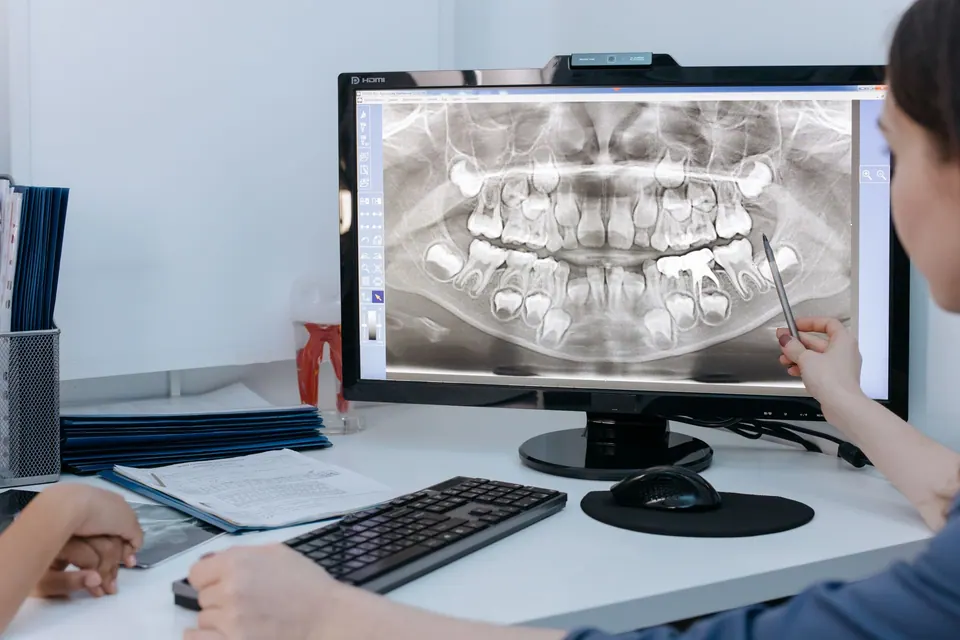
- an X-ray of the tooth, to look at the root tip, the quality of any existing treatment and whether there is a lesion;
- a check for cracks or root resorption, especially after trauma;
- an examination of the gum around the tooth.
Three situations can follow. If the pulp has died and the tooth has never been treated, a root canal treatment is carried out first. If there is an existing root filling that looks incomplete or is associated with a lesion, retreatment may be discussed, as explained in our article on root canal retreatment. If the root is healthy and well sealed, the cosmetic part can begin.
One point is worth stressing: after a knock, a tooth may darken slightly and then regain its colour, and tests can give false negative results for several weeks. Your dentist may therefore prefer to monitor it before treating the root.
Internal bleaching, step by step
Internal bleaching, sometimes called the walking bleach technique, places the whitening agent inside the tooth, in the space left by the root canal treatment, right where the pigment is. It is only suitable for a tooth that has already been root-treated.
The usual sequence:
- Isolating the tooth, ideally with a rubber dam, to protect the gum and avoid swallowing the product.
- Reopening the tooth from the back through a small, discreet access, and removing old materials and stained residue from the crown.
- Placing a tight seal over the root filling, slightly below gum level. This protects the root and limits leakage of the product towards the supporting tissues.
- Placing the bleaching agent in the pulp chamber, most often sodium perborate or a carbamide peroxide gel, followed by a temporary filling.
- A review a few days later: the shade is assessed and the agent renewed if needed. Two to a few appointments are generally required.
- The final restoration of the access cavity with a light composite, once the desired shade is reached and after a short wait that helps the bond.
This technique can be combined with external tray whitening to match the tooth to its neighbours; your dentist will tell you whether that combination is useful in your case.
Results, relapse and risks to know about
Internal bleaching often produces a clear improvement, but the outcome cannot be predicted precisely. It depends on how old the discolouration is, what caused it and how thick the tooth is.
A few facts to know before you start:
- Recent, blood-related staining generally responds better than staining from metallic materials or old cements.
- Some relapse of the shade is possible over the years; a new cycle can then be considered.
- The main risk is external cervical resorption, a slow breakdown of the root at the neck of the tooth. It was mainly described with highly concentrated products and the use of heat. Current protocols, with a tight seal and gentler agents, aim to reduce this risk, but X-ray follow-up is still recommended.
- A root-treated tooth remains more fragile than a living one. Bleaching does not strengthen it.
Internal bleaching is also not advised in some situations: a tooth too broken down to keep without a crown, a cracked root, uncontrolled infection or existing resorption. In those cases, another solution is offered.
When internal bleaching is not enough: veneer or crown
If the tooth stays too dark, or its structure does not allow bleaching, there are alternatives that mask the colour rather than lighten it.
- A ceramic veneer suits a tooth that is still sound, where only the visible surface is the problem. Masking a dark tooth is technically demanding: the ceramist needs a more opaque ceramic or enough thickness, which may require slightly more preparation than a standard veneer. Prior internal bleaching, even partial, often helps achieve a more natural result with a thinner veneer.
- A composite veneer is a simpler, repairable option, but masking a very dark shade naturally is harder.
- A crown is preferred when the tooth is weakened by large fillings or a crack. It protects the tooth by covering it completely. On a dark tooth, a core material able to hide the dark background is chosen.
In every case, the goal is to treat one tooth so that it blends in with its neighbours, which takes careful shade matching, photos and sometimes several try-ins. Our teeth whitening page describes the different types of whitening.
After treatment: protecting the tooth long term
Once the shade has been restored, the aim is to preserve both the appearance and the tooth itself.
- Avoid biting hard objects with that tooth (fruit stones, pens, nails): a root-treated tooth is less resistant.
- Report any change: a gradual return of discolouration, gum swelling, a small spot on the gum or pain when chewing.
- Keep up regular check-ups, with a follow-up X-ray at the interval your dentist suggests, to make sure the root stays healthy.
- Limit staining drinks and tobacco in the first weeks (coffee, strong tea), which can dull the composite that seals the access.
- Protect your teeth during contact sports if that is where the original injury happened: a custom mouthguard reduces the risk of another knock.
If the tooth was injured in an accident, the neighbouring teeth may also have been affected without showing it, and checking them is part of follow-up.
Having your grey tooth examined in Agdal
A tooth that darkens deserves an examination, even if it does not hurt. At German Dental Clinic in Agdal, the assessment starts with a digital X-ray of the tooth and sensitivity tests, to find out whether the root is healthy, needs treatment or needs retreatment. The cosmetic options are then discussed, from the most conservative (internal bleaching) to the most protective (a crown), along with their limits.
If you can, bring your previous records: X-rays, a root canal treatment report, the approximate date of the injury. They help to understand the tooth's history.
If you live in Rabat and one of your teeth has changed colour, you can book an appointment to have it assessed before choosing a solution.
Frequently asked questions
Is internal bleaching painful?
Generally not. Because the tooth has been root-treated, it no longer contains a sensitive nerve, and the product is placed inside it under isolation. Local anaesthetic is often unnecessary, or used only for gum comfort. Any discomfort or pain after an appointment should be reported, however, as it may signal irritation of the tissues around the root.
Can a tooth that went grey after a knock return to normal on its own?
Sometimes. Right after an injury, a tooth can take on a temporary pink or greyish tinge and then recover its colour if the pulp heals. If the discolouration persists or deepens over the weeks, or signs of infection appear, the pulp has probably died. Only follow-up with tests and X-rays can settle the question.
Can a crowned tooth be bleached internally?
No. A crown covers the whole tooth and does not whiten. If it looks grey, the cause is often a dark root or a metal framework showing at the gum line. The solution is then to replace the crown, sometimes with an all-ceramic one, after the root has been checked.
How long does the result of internal bleaching last?
The result often remains stable for years, but some re-darkening can occur over time, especially if the original staining was old or caused by materials. There is no guaranteed duration. If it relapses, a new cycle can sometimes be carried out, or a veneer discussed if the tooth no longer responds well enough.
Is internal bleaching possible for a teenager?
It can be considered for a teenager whose tooth was root-treated after an injury, with particular care, as the walls of the tooth can be thinner. It is often a useful option at that age, because it avoids cutting the tooth down while growth is still under way. Your dentist assesses whether it is suitable case by case.
The information on this page is general. Only a consultation allows a diagnosis and a suitable treatment plan.
A question about your own situation?
Dr Fenjero Walid sees patients in Agdal, Rabat, for an assessment and answers that fit your case.