Veneers or whitening: the short answer
If your teeth are well shaped and well aligned and only their colour bothers you, whitening is usually the first option: it lightens the tooth without removing anything from it. If the problem also involves shape, worn or chipped edges, small gaps or visible old fillings, veneers become relevant, because they change the whole appearance of the tooth, not just its shade.
Put simply, whitening works on the colour of the tooth you already have, while a veneer replaces the visible face of that tooth with a new one. The two are not rivals: in many cosmetic plans, the whole smile is whitened first and veneers are then placed only on the teeth that genuinely need them.
So the right choice does not come from a preference you walk in with, but from a clear look at what actually bothers you when you see yourself smile.
First question: is it only about colour?
In front of a mirror, many patients say their teeth are yellow when part of what bothers them is something else. Before talking about treatment, it helps to separate what is about shade from everything else:
- Overall colour: all the teeth look dull, yellow or dark in a fairly even way.
- One darker tooth: often linked to an old knock or a root canal treatment, it is dealt with separately.
- Shape: short, pointed or uneven teeth, edges worn down by age or grinding.
- Surface defects: small chips, visible craze lines, isolated white or brown spots.
- Old restorations: yellowed composite fillings, crowns lighter or darker than the teeth next to them.
- Position: teeth that sit back, are rotated or overlap.
If your list stops at the first line, whitening will probably meet your expectations. The more lines you tick, the more the answer becomes a combined plan. The exact causes of discolouration are covered in detail in our article on yellow teeth.
What whitening can do, and what it never will
Teeth whitening uses a peroxide-based gel that passes through the enamel and lightens the pigments inside the tooth. It adds nothing to the surface and removes no tissue, which is why it is the most conservative option for a smile that looks dull overall.
Its limits, however, are precise:
- It does not change the shape, length or alignment of the teeth. A chipped tooth stays chipped, just lighter.
- It has no effect on materials: composite fillings, crowns and existing veneers keep their original shade, which can create a contrast after treatment.
- How much lighter you get varies from person to person, depending on enamel thickness and the type of staining. Your dentist can give an estimate, never a guaranteed shade.
- The result changes over time: the shade drifts back slightly, faster in heavy coffee, tea or tobacco users, and a top-up may be suggested.
In practice, whitening works best on healthy teeth with few restorations, whose shape you already like.
When veneers become the logical answer
A dental veneer is a thin shell of ceramic or composite bonded to the visible surface of the tooth. In a single restoration it can correct colour, shape and surface texture.
Veneers are usually considered when:
- the shape or length of the front teeth does not suit you;
- the edges are worn, chipped or irregular;
- small gaps or slight misalignments need to be disguised;
- deep staining does not respond to whitening;
- several old restorations in different shades need to be harmonised.
On the other hand, placing veneers on badly positioned teeth often means removing more tooth to make up for the alignment. In that case, straightening the teeth first is generally kinder to them. And when a tooth is heavily broken down, a crown may suit it better than a veneer, a question we cover in veneers or crowns.
Veneers are therefore not a stronger form of whitening: they are restorations, with their own indications, upkeep and eventual replacement.
Reversibility: what each option commits you to
This is often the deciding factor, and it deserves to be stated plainly before you choose.
Whitening takes nothing away from the tooth. If you are disappointed by the result, or it fades, you have lost nothing: you can have a top-up, or consider another solution later. The temporary sensitivity that is common during treatment usually settles within a few days.
Veneers commit the tooth for the long term. Depending on the case, preparation ranges from almost no reduction at all (so-called no-prep or minimal-prep veneers) to the removal of a few tenths of a millimetre of enamel. Once enamel has been altered, the tooth will need a restoration for the rest of its life: a worn, debonded or outdated veneer is replaced with another one, not removed to return to the original tooth.
Composite sits in between: it is often bonded with little or no preparation and is easy to repair or adjust, but it loses its shine and picks up stains faster than ceramic.
For a young patient with healthy teeth, this reasoning naturally points to starting with the least invasive option and keeping veneers for the defects whitening cannot correct.
Combining both: whitening first, veneers second
When both treatments are useful, the order matters. The usual rule is to whiten first, for a simple reason: a ceramic veneer does not whiten. If veneers are matched to teeth that are still yellow and the neighbouring teeth are whitened afterwards, the veneers will look darker than the rest of the smile.
A typical sequence looks like this:
- assessment and professional cleaning, to start from the true shade of your teeth;
- whitening of all visible teeth;
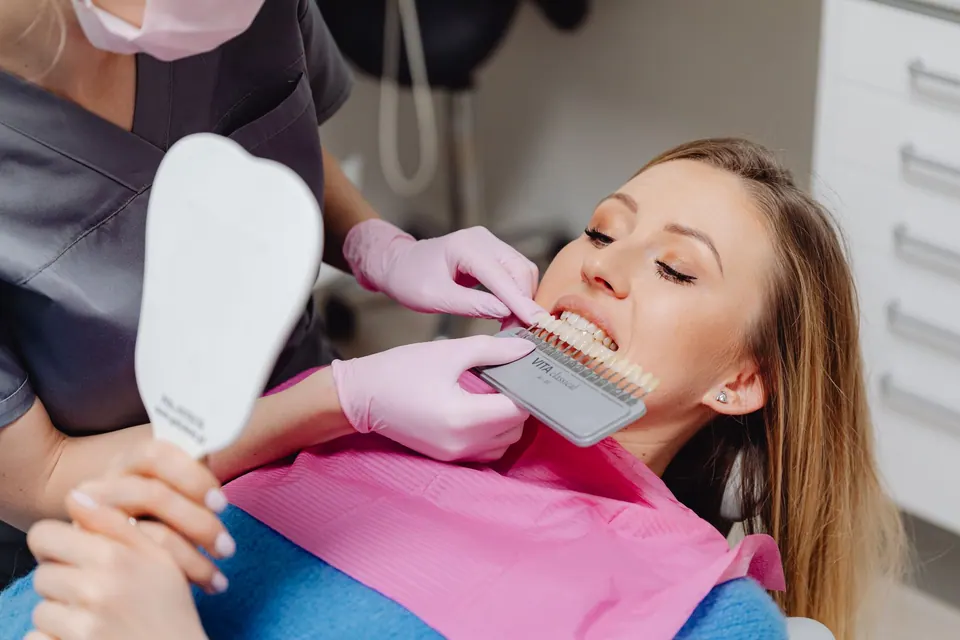
- a settling period: the shade stabilises over the following days, and bonding to freshly whitened enamel is less reliable, so there is generally a wait of one to two weeks before shade taking and bonding;
- choosing the veneer shade to match the new colour;
- placing veneers only on the teeth that need them.
This approach often reduces the number of veneers: two reshaped incisors on a whitened smile may be enough where six or eight teeth were first imagined. A visual plan beforehand, with photos and a trial in the mouth, helps you see this balance before any tooth is touched.
Deciding in Rabat: questions to ask your dentist
A sound choice between veneers and whitening rests on an examination, photos of your smile and an honest conversation about your expectations. A few useful questions to ask at the consultation:
- Will my type of staining respond to whitening, and what change can I reasonably expect?
- Will my old fillings or crowns need replacing after whitening?
- Which teeth genuinely need a veneer, and why?
- How much enamel would be altered on each one?
- How will the result be maintained over time?
At German Dental Clinic in Agdal, a cosmetic assessment starts with the health of your teeth and gums: decay, tartar or inflammation are treated before any cosmetic work. Photos and a digital impression are then used to discuss the options in concrete terms, including the simplest one.
If you are torn between whitening and veneers and live in or around Rabat, you can book an appointment for a smile assessment.
Frequently asked questions
Can existing veneers be whitened?
No. Whitening products act on the pigments of natural teeth, not on ceramic or composite. A veneer keeps the shade chosen on the day it was fitted. If you want a lighter smile later, the visible natural teeth are whitened and, if the difference becomes noticeable, the veneers concerned are replaced.
How long should I wait between whitening and veneers?
The usual wait is one to two weeks after whitening ends. This gives the shade time to stabilise, so the veneer colour can be chosen on a reliable basis, and lets the enamel recover good bonding conditions. Your dentist adjusts the timing to your situation and the material chosen.
Do I need to whiten all my teeth if I only get two veneers?
It is not compulsory, but it is often sensible if the neighbouring teeth look yellow to you. Veneers are matched to the teeth around them: if those teeth are whitened first, the veneers can be made in a lighter shade and still blend in. Otherwise, they are matched to your current colour.
Do veneers last longer than whitening?
The two results are not really comparable. Whitening fades gradually and can be topped up without harming the tooth. A veneer keeps its colour, but it is a restoration that ages: it can wear, chip or come off, and will one day be replaced. How long it lasts depends on hygiene, the material and habits such as grinding.
Do veneers weaken teeth?
A well-indicated veneer bonded mainly to enamel does not weaken the tooth; the bond actually reinforces the treated surface. The risk rises when preparation is extensive or the tooth is already heavily restored. That is why minimal preparation is preferred whenever the case allows it, after the plan has been studied.
The information on this page is general. Only a consultation allows a diagnosis and a suitable treatment plan.
A question about your own situation?
Dr Fenjero Walid sees patients in Agdal, Rabat, for an assessment and answers that fit your case.