
Gap teeth: how can a diastema be closed?
A space between two teeth is called a diastema. The best known sits between the two upper front teeth, a feature some people love and others want closed. There are three approaches: moving the teeth together with orthodontics, for example clear aligners, widening the teeth with bonded composite, or covering them with veneers. Often the best solution combines two of these.
The choice depends first on the cause of the gap, then on its width, the shape of the teeth and the health of the gums. One point is worth making from the outset: a gap that appears or widens in adulthood is not only a cosmetic matter. It can signal gum disease and should be examined.
Finally, nothing obliges you to close a stable gap if your gums are healthy. It is an aesthetic decision, and it is yours to make.
Where the gap comes from: identifying the cause
A diastema has no single cause. The dentist looks for the one at work, because it shapes the treatment and the risk of the gap reopening:
- teeth too small for the arch: narrow lateral incisors, sometimes cone-shaped (peg laterals), leaving spaces on either side;
- a congenitally missing tooth, often a lateral incisor, which redistributes the spaces;
- a thick or low-attached upper lip frenum, whose fibres run between the central incisors;
- habits: the tongue pushing against the teeth when swallowing, prolonged sucking, the lower lip resting behind the upper teeth;
- periodontal disease: as the bone around the roots is lost, the incisors can spread and drift forward, known as pathological migration;
- an extra tooth hidden between the roots of the central incisors, visible on an X-ray, which prevents the gap from closing;
- a lost tooth that has not been replaced, allowing its neighbours to drift apart.
A simple test can sometimes point the way: gently pulling the upper lip upwards, gum that blanches between the incisors suggests the frenum is involved. It is only a clue; the clinical examination and the X-ray decide.
In children: a gap that is often normal
Around age 8 or 9, many parents worry about a gap between the upper permanent incisors, sometimes with teeth fanning outwards. This is a familiar stage of the mixed dentition: the incisor roots are still tilted by the canines descending above them. When the canines come through, around 11 or 12, the gap often narrows on its own.
An opinion is still useful when the gap is wide, when it persists after the canines arrive, or if a tooth does not come through at all. An X-ray can then look for an extra or missing tooth. As for the lip frenum, current practice is not to intervene too early: the first step is to see whether the gap closes naturally, and any procedure is discussed case by case. Our article on tongue and lip ties covers these situations in more detail.
Bringing the teeth together: the orthodontic route
When the teeth are of normal size and shape, moving them together is the most conservative option: no material is added and no tooth is drilled. Clear aligners suit many single gaps and moderate multiple spaces. Fixed braces remain an option an orthodontist may propose for more complex cases.
Orthodontics can also redistribute spaces rather than close them completely. If the lateral incisors are small, it is often more harmonious to share the space around them and then give them a normal size with composite or veneers. Where a tooth is missing, orthodontics can open or close the space depending on how it will be replaced.
A diastema is one of the movements most prone to relapse. Once the gap is closed, a bonded retainer wire behind the incisors is very often recommended, sometimes combined with a night-time retainer. If a thick frenum is involved, treating it is generally considered after the gap has closed, so that the healing tissue helps stabilise the result.
Widening or covering: composite bonding and veneers
Composite bonding means adding composite resin to the sides of the teeth to narrow or close the gap. Its strengths are real:
- no drilling, or only minimal enamel preparation;
- a result often achieved in a single visit;
- a technique that can be repaired and is largely reversible.
Its limits come down to proportions and the material itself. Closing a large gap only by widening two incisors makes them too broad, almost square. Composite can also stain or chip over time and needs maintenance polishing. And if the gum does not fill the space, a small black triangle may remain near the gum line.
Ceramic veneers come into their own when the shape or colour of the teeth is also a concern, or when several teeth are involved. They offer excellent colour stability but usually require some enamel preparation. Our article on composite versus ceramic veneers compares the two materials. In every case, a trial in the mouth beforehand (a mock-up) lets you judge the result before anything permanent is done.
Choosing according to your situation
A few typical situations help explain the decision-making, which always depends on the individual mouth:
- a small gap between two normal-sized incisors: aligners, or composite if you want a quick solution and proportions allow it;
- small or peg-shaped lateral incisors: restoring their size with composite or veneers, sometimes after a short orthodontic phase to distribute the spaces;
- several gaps along the arch: orthodontics first, because composite alone would widen every tooth;
- teeth spreading because of gum disease: gum treatment comes first; once the inflammation is stable, careful realignment can be considered, followed by long-term retention;
- a missing tooth: the replacement plan (implant, bonded bridge, moving neighbouring teeth) is decided before spaces are closed or opened.
Ask your dentist two simple questions: what is causing my gap, and what happens if it reopens? The answers say a lot about which solution will last best.
Closing a diastema in Agdal: the assessment
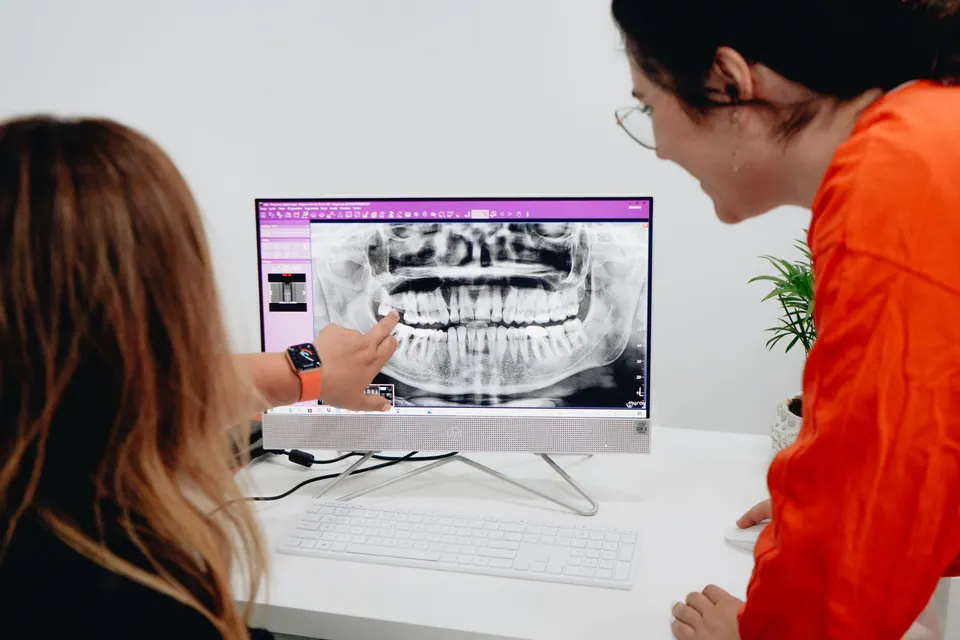
At German Dental Clinic in Agdal, assessing a diastema starts with an examination of the teeth, the lip and its frenum, the tongue and the gums, with periodontal probing if the gap is recent. A panoramic X-ray and a digital impression with the intraoral scanner complete the picture and allow the result to be simulated.
The dentist then sets out the options for your case, with their advantages, limits and retention plan. If you are unsure how the result will look, an aesthetic trial in the mouth helps you decide calmly. If you live in Rabat and the gap between your teeth bothers you, or has recently widened, you are welcome to book an appointment.
Frequently asked questions
Does a gap between the front teeth need correcting?
No, not if the teeth and gums are healthy and the gap is stable. It is then simply a feature of your smile, one that many people happily keep. Correction makes sense if the gap bothers you, traps food, affects your speech or is getting wider, and in that last case the gums should always be checked.
Can a diastema be closed in one visit?
It can with composite bonding, when the gap is moderate and the teeth can be widened slightly without losing their proportions. The visit usually involves no anaesthetic and no drilling. For a large gap or several spaces, a quick fix risks producing teeth that look too wide, so orthodontics, alone or combined, is more suitable.
Does the lip frenum have to be cut to close the gap?
Not routinely. A frenum is only implicated if it is thick, attached very low and its fibres pass between the incisors. Even then, the procedure is often considered after the gap has been closed orthodontically, to help stability. In children, the usual approach is to wait and see whether the gap closes as the canines arrive.
Why has a gap appeared between my teeth at 45?
A gap that appears in adulthood always has a reason. The most important one to rule out is periodontitis, which reduces the supporting bone and lets teeth drift. Other causes include a missing tooth that was never replaced, tongue pressure, or lost back teeth overloading the incisors. A gum examination and an X-ray help establish the origin.
Can the gap come back after treatment?
Yes, it is one of the spaces most likely to reopen, especially if it was wide or linked to the frenum or tongue. That is why a bonded retainer behind the incisors is very often advised after orthodontic closure. After bonding, the gap does not reopen in the same way, but the composite needs regular maintenance.
The information on this page is general. Only a consultation allows a diagnosis and a suitable treatment plan.
A question about your own situation?
Dr Fenjero Walid sees patients in Agdal, Rabat, for an assessment and answers that fit your case.