
Crowded teeth: the short answer
Overlapping teeth, which dentists call dental crowding, are corrected by moving them, with aligners or fixed braces, once the missing space has been created. That space comes from slightly widening the arch, from removing a minimal amount of enamel between certain teeth or, in severe cases, from extracting teeth chosen by the orthodontist.
Veneers do not straighten anything. They change the shape and colour of the visible surface of the teeth. Used to disguise crowding, they often mean cutting back the most prominent teeth heavily, which runs against modern dentistry and its focus on preserving tooth tissue.
Even before appearance, crowding deserves attention for a simple reason: misaligned teeth are harder to clean, and the gums often pay the price.
Why teeth become crowded
Crowding usually comes from a mismatch between the size of the teeth and the space available in the jaw. That relationship is largely inherited, but other factors play a part:
- early loss of a baby tooth, letting neighbouring teeth drift into the gap and leaving no room for the permanent tooth;
- a baby tooth that does not fall out, forcing the permanent tooth to come in beside it;
- childhood habits such as thumb sucking, mouth breathing or a low tongue posture, which influence the shape of the arch;
- age: even without any history, the lower front teeth tend to crowd gradually in adulthood, through a slow natural forward drift;
- relapse after orthodontic treatment without adequate retention;
- loss of a back tooth that is not replaced, so the neighbours tip and alignment breaks down;
- gum disease: in adults, incisors that suddenly fan out and overlap can signal bone loss around the roots.
Wisdom teeth often get the blame. Their role in late crowding of the incisors has not been established as a main cause, and removing them is not, on its own, a treatment for crowding.
More than looks: hygiene, gums and wear
A well-aligned arch almost cleans itself as the brush passes. Once teeth overlap, nooks appear where plaque settles and bristles cannot reach. Possible consequences include:
- gum inflammation and localised bleeding around the crowded teeth;
- more tartar, especially behind the lower incisors;
- decay between teeth, where floss struggles to pass;
- gum recession on a tooth pushed outside the arch, as the bone covering it is often very thin;
- wear or small chips on the edges of incisors that collide at an angle;
- repeated food trapping between two staggered teeth.
Until any treatment, your routine can adapt: interdental brushes where they fit, floss elsewhere, and a single-tuft brush (a small head with one tuft of bristles) to follow the outline of teeth set further back. Regular professional cleaning completes this. These measures limit the damage, but they do not replace alignment when it is indicated.
Straighten rather than hide: the orthodontic options
The principle never changes: create space, then guide each tooth into position. There are three levers, often combined:
- moderate arch widening, by uprighting teeth tilted inwards;
- interproximal enamel reduction (stripping): the clinician removes a very thin layer of enamel from the contact surfaces of selected teeth, then polishes them; it stays within the enamel and is planned to a tenth of a millimetre;
- extraction, reserved for severe crowding or certain facial profiles, decided by an orthodontist after analysing the face and jaws.
For mild to moderate crowding, clear aligners are often a suitable option: after a digital impression, the movement is simulated on screen, small attachments bonded to some teeth give the tray grip, and a series of transparent trays follows. Very marked rotations, teeth sitting far back or jaw discrepancies are more often a job for fixed braces. Our article on aligners versus metal braces compares the two in detail.
Once the teeth are aligned, retention protects the result: without it, corrected crowding has a strong tendency to come back. Our article on retainers after aligners or braces explains how they work.
When veneers are not the right answer
You may come across promises of “instant orthodontics”: veneers or crowns placed on crowded teeth to produce an aligned smile in a few visits. Simple mechanics explain why this is rarely a good choice.
- To line up a tooth that sits forward, it has to be cut back into the arch: the preparation often goes beyond the enamel and can come close to the pulp, sometimes to the point where root canal treatment becomes necessary.
- To line up a tooth that sits back, a thick veneer is needed, creating a bulky contour that is hard to clean and irritates the gum.
- The bite stays the same: chewing forces remain poorly distributed, which weakens the ceramic.
- It cannot be undone: a prepared tooth stays prepared, and the veneers will need replacing one day.
Veneers remain fully relevant when the irregularity is minimal and comes with a genuine shape or colour problem, or after alignment. Straightening the teeth first can then greatly reduce, or even avoid, preparation. This is the idea of the treatment gradient: start with the least invasive step that solves the problem.
In adults: what to check before starting
Treating crowding at 35 or 55 is entirely possible, provided the groundwork is known.
- Gums and bone are assessed first. Active periodontitis must be treated and stabilised, because moving teeth in inflamed supporting tissue worsens bone loss.
- Thin gums around the lower incisors are watched closely, as some outward movements can encourage recession.
- Crowns, bridges and implants are built into the plan: an implant does not move with orthodontics.
- Decay and failing fillings are treated before attachments are bonded or enamel reduction begins.
- Long-term retention is planned from the start, because teeth in adults, as in teenagers, keep a tendency to move back.
This preliminary assessment determines the safety of treatment and the stability of the result far more than the choice of appliance itself.
Having crowded teeth assessed in Agdal
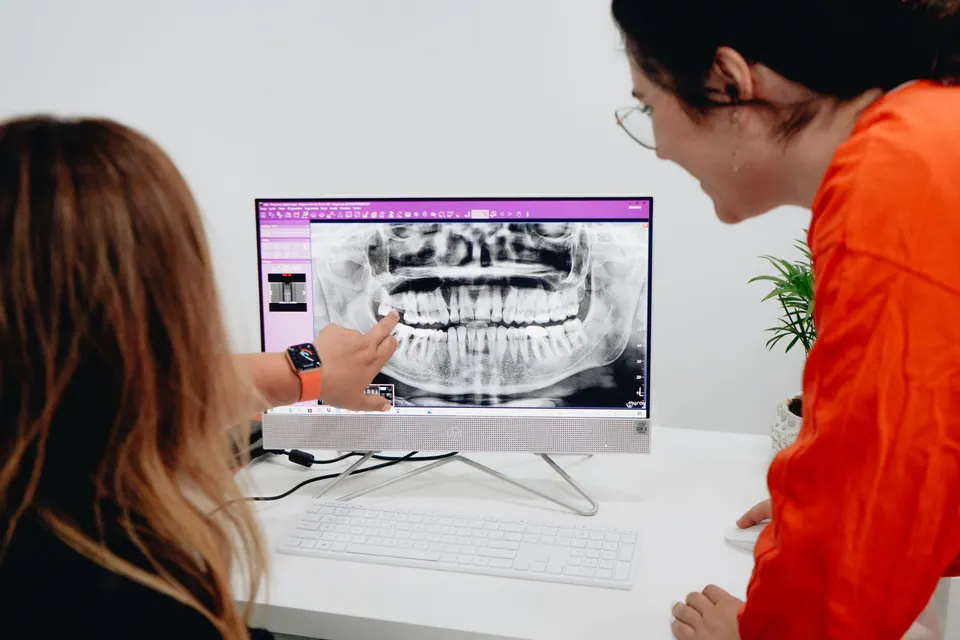
At German Dental Clinic in Agdal, the first appointment starts with an examination of the teeth, gums and bite, completed by a panoramic X-ray and a digital impression with the intraoral scanner. These records make it possible to measure the missing space and visualise the planned movement.
If your crowding can be treated with aligners, the dentist shows you the plan, any areas of enamel reduction and the retention to follow. If it calls for fixed braces or specialist orthodontic care, you will be told so clearly. And if you have been offered veneers to hide crowded teeth, a second opinion helps you compare options before any irreversible step.
To review your alignment in Rabat, you are welcome to book an appointment.
Frequently asked questions
Can crowded teeth be corrected without a brace?
Moving a tooth requires an appliance, fixed or removable. Without orthodontics, only a very slight irregularity can be disguised, for instance by reshaping an edge with composite. As soon as the crowding is visible, this camouflage quickly reaches its limits and may require cutting healthy teeth. An assessment shows what movement is actually needed.
My lower teeth are getting more crowded with age: is that normal?
It is common. The lower incisors tend to close up gradually in adulthood, even in people who have never worn a brace. It is not serious in itself, but if cleaning becomes difficult, the gums become inflamed or the crowding worsens quickly, a check of the gums and bone is worthwhile before considering alignment.
Should wisdom teeth be removed to prevent crowding?
The link is often mentioned, but it has not been established as a main cause of crowding. Wisdom teeth are removed for other reasons: infection, decay, a cyst, pain or a lack of room to erupt. Taking them out does not replace orthodontic treatment or retention once the teeth have already started to move.
Does enamel reduction damage the teeth?
Done properly, staying within the enamel, in planned amounts and with careful polishing, it is considered safe. Published research has not shown an increased risk of decay under these conditions. A fluoride application can complete the procedure, and some brief, mild sensitivity is possible.
How long does treatment for crowded teeth take?
It depends on the space to be created, the number of teeth to move and how consistently you wear your aligners. Mild crowding of the front teeth is generally treated in a few months, while severe crowding takes longer. An estimate for your case is given after digital planning, and retention then takes over.
The information on this page is general. Only a consultation allows a diagnosis and a suitable treatment plan.
A question about your own situation?
Dr Fenjero Walid sees patients in Agdal, Rabat, for an assessment and answers that fit your case.