
Can a Hollywood smile look natural?
Yes, provided it is designed around your face rather than taken from a catalogue. A natural result rests on three choices: a light but believable shade, varied tooth shapes suited to your age and features, and proportions that match your lips and gums. A trial in the mouth before any permanent treatment allows these choices to be checked.
The term "Hollywood smile" usually refers to transforming several visible teeth, most often with veneers, sometimes combined with crowns, whitening or gum reshaping. The number of teeth treated depends on how wide your smile is: some people show six teeth, others ten or more.
So the problem is not the technique but how it is applied. A smile that is "too perfect" is spotted instantly; a well-planned smile mainly makes you look rested and well.
Why some redone smiles look fake
Artificial-looking results usually share the same, easily recognised causes:
- A shade that is too white and uniform. Very light, opaque shades that are identical on every tooth create a "porcelain teeth" look that clashes with the whites of the eyes and the skin.
- Teeth that are all the same. In nature, the canine does not look like the central incisor, and the lateral incisors are smaller. Copy-and-paste teeth look false.
- Too much bulk. Overly thick veneers placed without preparation on teeth that already stand forward make the mouth look puffy and push the lip out.
- Edges that are too regular. A perfectly straight biting edge, with no slight translucency or variation, lacks life.
- Ignored gums. Gum margins at uneven heights or inflamed gums give the work away, even with beautiful teeth.
There is also a more worrying trend: crowning healthy teeth after heavily grinding them down to save time. That is precisely the approach modern aesthetic dentistry tries to avoid.
Choosing the right shade
The ideal white is not the whitest possible. It should suit the whites of your eyes, your complexion and the age of your face. A shade that works on screen or under studio lights can look chalky in daylight.
A few principles guide the choice:
- a natural tooth is not one single colour: it is more saturated near the gum and more translucent at the edge, and good ceramics reproduce this gradient;
- canines are naturally slightly deeper in shade than incisors, and this nuance gives the smile depth;
- untreated teeth (often the lower ones) must stay in harmony, so teeth whitening may be suggested beforehand to avoid a mismatch.
The shade is chosen in daylight, using shade guides and photographs, and confirmed on the trial mock-up. Getting two opinions, yours and that of someone close to you, often helps you decide.
Shape and proportions: what is assessed
The dentist starts not from the teeth but from the face. Several reference points are analysed on photographs and video:
- the midline of the face and that of the central incisors;
- the smile line: ideally, the edges of the upper teeth follow the curve of the lower lip;
- the visible length of the incisors at rest and when smiling, which naturally decreases with age;
- the width to length ratio of the central incisor: a tooth that is too wide looks square and heavy, one that is too narrow looks fragile;
- the progression of the teeth from front to back, and the small spaces between the edges (embrasures) that give relief.
Shape is also personalised: softer and more rounded for some faces, more defined for others. Geometric rules such as the "golden proportion" are sometimes quoted, but they remain debated guidelines, not norms to apply mechanically.
Finally, the gums matter as much as the teeth: even, symmetrical gum margins and healthy tissue are the foundation of a harmonious smile.
Try before you decide: digital design and mock-up
A natural smile is built step by step, with you having the final say:
- Analysis and photographs. Portraits, posed and spontaneous smiles, speech: the plan is based on your real expressions.
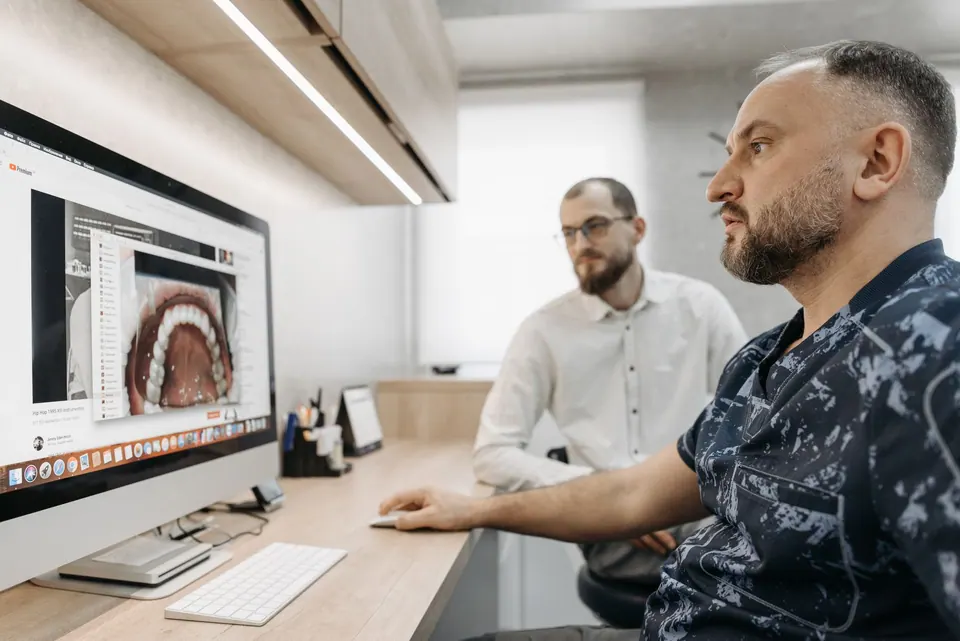
- Digital design. Using photographs and an intraoral scanner impression, a smile design is drawn and then turned into a wax-up.
- Mock-up in the mouth. A temporary resin placed over your teeth, without touching them, lets you see and "wear" the future smile, talk, look at yourself and request changes.
- Final treatment. Once the design is approved, the veneers or crowns are made to follow this model.
Our article on digital smile design and mock-ups explains this step in detail. It is also the moment to ask for adjustments: slightly shorter edges, a less white shade, less pointed canines. Whatever is corrected on the mock-up does not need correcting in the mouth.
Materials, preparation and limits to be aware of
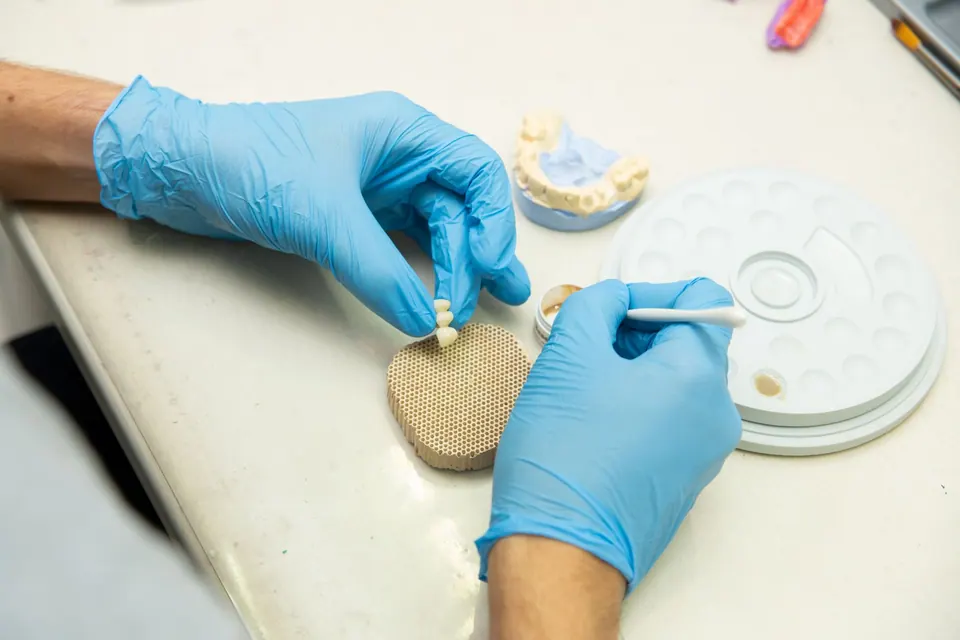
A natural result also depends on the material. Bonded ceramics, such as lithium disilicate or feldspathic porcelain, reproduce the translucency of enamel well. Composite allows lighter, reversible changes, with more regular maintenance: see our comparison of composite or porcelain veneers.
Preparation should remain as conservative as possible. When teeth stand well forward or are crooked, prior alignment with clear aligners can reduce the amount of enamel that has to be removed. Conversely, badly damaged teeth may need crowns rather than veneers.
Limits to be aware of:
- the treatment is not reversible once enamel has been prepared;
- temporary sensitivity is possible after preparation;
- veneers do not whiten and may one day need replacing;
- bruxism calls for a night guard;
- decay, inflamed gums or gum disease must be treated first.
Our Hollywood smile page outlines the treatment journey.
Preparing your project in Rabat: the right questions
Before committing, it helps to arrive at the consultation with clear ideas while staying open to advice. Bring photos of smiles you like, bearing in mind that they help the dentist understand your taste, not copy a model.
Questions to ask:
- how many teeth need treating for my smile, and why?
- will my healthy teeth be prepared, and by how much?
- can I try the result in my mouth before deciding?
- which shade do you recommend, and how will it match my untreated teeth?
- what maintenance and check-ups should I plan for?
At German Dental Clinic in Agdal, the project starts with a full examination, X-rays and photographs, followed by a digital impression; the design stages can rely on CAD/CAM where appropriate. The aim is a smile that looks like you. If you live in or around Rabat, you can book an appointment for an initial analysis of your smile.
Frequently asked questions
How many teeth need treating for a Hollywood smile?
It depends on how wide your smile is. Treatment usually covers the teeth that show when you smile broadly, often between six and ten upper teeth, sometimes the lower ones as well. Treating too few can leave a visible contrast at the sides, while treating too many adds nothing. Photo analysis defines the right number.
Which shade should I choose to avoid the over-white look?
The right shade is light but matches the whites of your eyes and your skin. The most extreme, very opaque shades are the ones that look most artificial. The choice is made in daylight and confirmed on a trial mock-up, taking into account the teeth that will not be treated.
Do my teeth have to be filed down?
Not always. Some situations allow no-prep veneers or very light preparation limited to the enamel. But when teeth stand forward or are heavily discoloured, preparation is needed to avoid overly thick veneers. Prior alignment can sometimes reduce the preparation required. Your dentist will tell you exactly what is planned.
Is a Hollywood smile permanent?
No restoration lasts forever. Well-designed and well-maintained porcelain veneers generally last many years, but they may one day need replacing (fracture, gum recession, wear). Composite needs touch-ups more often. Good hygiene, regular check-ups and a night guard if you grind your teeth all extend their service life.
Can I see the result before treatment?
Yes, and it is strongly recommended. After the analysis and digital design, a resin mock-up is placed temporarily over your teeth without preparing them. You can look at yourself, smile, talk and ask for changes. The final treatment only begins once you have approved the design.
The information on this page is general. Only a consultation allows a diagnosis and a suitable treatment plan.