What is a post and core?
A post and core (known in French as an inlay core) is a custom-made artificial core anchored in the root of a root-treated tooth. It replaces the part of the tooth that has been destroyed and acts as a foundation for a crown. It is indicated when too little tooth remains above the gum to hold a crown reliably. It is not routine: when enough sound walls remain, a bonded composite build-up, with or without a fibre post, or a partial restoration may be enough.
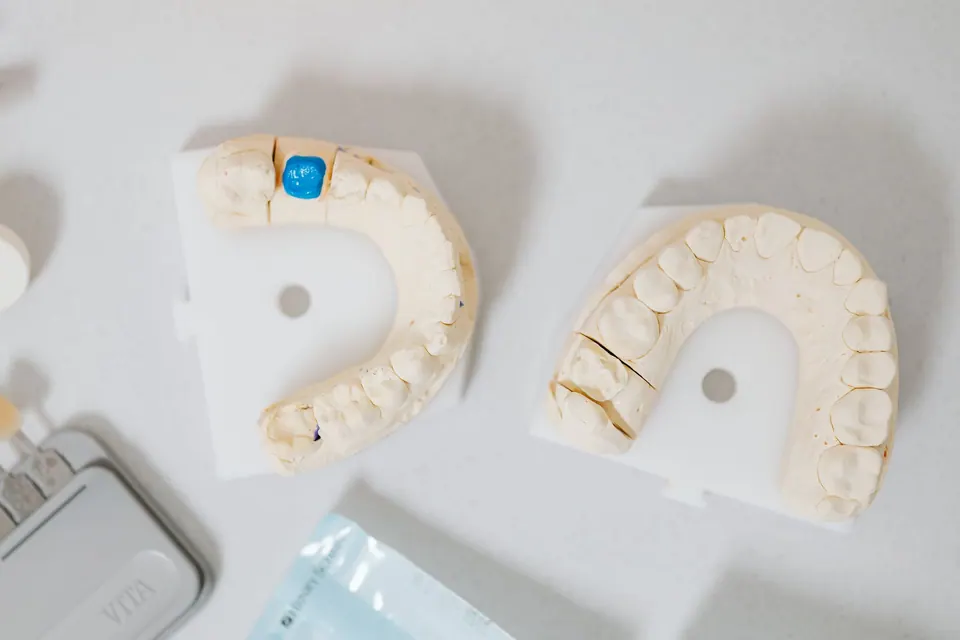
The name describes the two parts of the piece. The post is a rod that fits into the previously treated root canal. The core is the part that sticks out and reproduces the shape of a prepared tooth, ready to receive the crown. Together they form a single unit, made in a laboratory or milled from an impression.
Dentists also speak of a cast post and core or a radicular reconstruction. These terms all describe the same family of solutions: giving a badly broken-down tooth a solid base before it is crowned.
Does every root-treated tooth need a post and core?
No, and this is a common misconception. A post does not strengthen the root: its only job is to retain the build-up material when the tooth no longer offers enough surface to hold it. Preparing a space in the canal actually removes some dentine and, if it is too wide or too long, can weaken the root.
The decision depends mainly on how much tooth remains after the canals have been treated and the decay removed:
- several thick, sound walls: a bonded composite build-up without a post is often enough, followed by a crown or an onlay;
- one or two remaining walls: a bonded fibre post can help retain the composite;
- very little tissue above the gum, especially on an incisor or premolar: a post and core is then a classic option;
- a molar with a large pulp chamber: a single bonded piece anchored in the chamber, called an endocrown, is sometimes preferable to a post. Our article on ceramic inlays and onlays explains this partial-restoration approach.
One criterion matters especially: a band of sound dentine all the way round the tooth, above the margin of the future crown. Specialists call this the ferrule effect. The more of it there is, the better the crowned tooth resists chewing forces, whatever the type of build-up.
Cast or milled post and core: the materials
A post and core is made in two main ways:
- Cast: the shape is modelled in wax or resin, then cast in metal in the laboratory using the lost-wax technique. The alloys are most often non-precious (nickel-chromium, cobalt-chromium), less often precious. This is the traditional, proven and very rigid technique.
- Milled: the piece is designed on a computer from an impression, then milled from a block. Depending on the system, it may be metal, zirconia or reinforced composite.
Each material has its own characteristics:
- metal is very strong and suits heavily damaged teeth, but it is dark: under an all-ceramic crown it can dull the shade, particularly near the gum on a front tooth. Its stiffness, far greater than that of dentine, also concentrates stress in the root;
- zirconia is light-coloured and aesthetic, but also very stiff, and extremely difficult to remove if the tooth needs retreatment later. Its use as a post has become more limited;
- milled reinforced composites have a stiffness closer to dentine and can be bonded, but whether they are suitable depends on how much tooth remains.
The choice therefore does not rest on a single criterion: it takes into account the tooth, its position, the planned crown and the possibility of future retreatment.
Fibre post and composite: the bonded alternative
A composite build-up with a fibre post is now often proposed when the tooth retains enough tissue. The post is a prefabricated rod of glass or quartz fibres embedded in resin. It is bonded into the canal, then the core is built up in composite directly in the mouth, in a single visit.
Its advantages:
- a stiffness close to that of dentine, which distributes forces in the root more evenly;
- bonding to the tooth, which limits leakage;
- a light colour that works with a ceramic crown;
- usually easier removal than a metal or zirconia post if the canals need retreatment;
- when failures occur, fractures that are more often repairable, as the root is less exposed to a vertical fracture.
Its limits: it requires excellent bonding conditions, ideally under a rubber dam, and it is less suitable when the tooth is almost completely destroyed above the gum, or when the axis of the core must be corrected noticeably relative to the root. In those situations, a custom post and core remains a logical solution.
In the end, the real question is not which technique is superior, but how much tooth is left, and where.
The steps: from the root to the crown
For a post and core, the process usually goes like this:
- Checking the root canal treatment: the root canal treatment must be well sealed with no active lesion. If in doubt, retreatment is discussed before any build-up, because a post makes later access to the canals harder.
- Preparing the post space: part of the canal filling is removed to a set length, leaving a plug of material at the bottom to keep the seal near the root tip. The walls of the tooth are then shaped.
- Impression: conventional, with a material that flows into the post space, or digital where the situation allows. A temporary tooth protects the tooth between visits.
- Fabrication: casting in the laboratory or milling.
- Cementing or bonding the post and core into the root, after checking its fit.
- Final preparation and crown: the rebuilt tooth is prepared like a natural core, then the dental crown is made.
With a fibre post, the build-up is done directly in the mouth, which usually means fewer visits. In every case, it is best not to wait too long between finishing the root canal treatment and the final build-up: a leaking temporary filling lets bacteria recontaminate the canals.
Risks, limits and care
Like any restoration, a post and core has points to watch:
- root fracture: this is the most feared complication, especially with a stiff post in a thin root, or in someone who clenches or grinds. A vertical fracture most often leads to extraction;
- debonding: the post and core can come loose together with the crown, as one piece. This can often be put right if the root is intact;
- decay under the crown: the junction between crown and tooth remains a weak spot that needs careful cleaning;
- perforation of the root while preparing the post space, rare but possible in curved or narrow roots;
- difficult retreatment: removing a metal or zirconia post is delicate and carries a risk to the root.
Care is the same as for any crowned tooth: careful brushing at the gum line, daily cleaning between the teeth, regular check-ups with X-rays on the proposed schedule, and a night guard if you grind. A root-treated tooth no longer signals pain in the same way: decay or a crack can progress without warning, which is why check-ups matter. For the crown itself, our article on crown steps and materials completes this information.
Questions to ask and assessment in Agdal
Before rebuilding a root-treated tooth, a few questions help you understand what is being proposed:
- how much sound tissue remains above the gum, and all the way round the tooth?
- is a post really necessary, or would a bonded build-up be enough?
- which material is planned for the post and for the crown, and why?
- does the root canal treatment look good on the X-ray?
- what would happen if the tooth ever needed retreatment?
At German Dental Clinic in Agdal, the assessment of the tooth relies on digital radiography and, depending on the case, an intraoral scanner impression, which helps choose the right build-up before the crown. If you live in Rabat and a root-treated tooth needs rebuilding, you can book an appointment to discuss it.
Frequently asked questions
Is having a post and core fitted painful?
Usually not. Because the tooth has been root treated, it no longer has a nerve, and preparing the post space is often painless; the gum can be numbed if the preparation margin is close to it. After fitting, mild gum discomfort or tenderness when chewing may appear for a few days. Pain that persists should be reported.
How many visits do a post and core and a crown take?
Usually several: one visit for preparation and impression, fitting of the post and core once it has been made, then preparation and fitting of the crown, with some steps possibly combined. With a fibre post built up in composite, the build-up is done in a single visit. The exact number depends on the tooth, the materials and the fabrication, and is given in your treatment plan.
Does a metal post and core show through the crown?
On a back tooth, rarely. On a front tooth, a metal core can darken a very translucent crown or reveal a grey line if the gum recedes. A more opaque crown, a light-coloured core or a fibre post build-up can then be chosen. This is discussed before treatment, according to the shade you want and how thin your gum is.
Can a post and core be removed if the tooth becomes infected again?
Often yes, but it is delicate. A cemented metal post is removed with specific instruments, with a risk of weakening or cracking the root. A zirconia post is very difficult to remove, whereas a fibre post is generally easier to take out. When removal is too risky, apical surgery may be discussed to treat the infection from the root tip.
Post and core or fibre post: which is stronger?
There is no outright winner. A metal post and core is very strong in itself, but its stiffness can encourage root fractures that are hard to repair. A fibre post flexes more, somewhat like dentine, and its failures are more often repairable, but it needs enough remaining tissue. The most protective factor remains the amount of sound dentine preserved around the tooth.
The information on this page is general. Only a consultation allows a diagnosis and a suitable treatment plan.