
Crown fallen out: what to do straight away
If your crown has come off, keep it, rinse it with water, put it in a small box and call your dentist promptly: in many cases it can be recemented if the tooth underneath is healthy. Never glue it back with superglue or any household adhesive, and avoid chewing on that side in the meantime. A crown that feels loose without coming off should also be seen fairly soon, because the movement lets bacteria and saliva seep under it.
While you wait for your appointment:
- look inside the crown: if it contains a piece of tooth or the whole core, mention it on the phone, as this already points towards the diagnosis;
- gently brush the exposed tooth, which may be sensitive to cold and heat, using a toothpaste for sensitive teeth if needed;
- avoid hard, sticky or very sugary foods on that side;
- do not put the crown back in overnight: you could swallow it or, more rarely, inhale it;
- temporary dental cement kits sold in pharmacies can help for a few days if your dentist advises it, but a badly seated crown upsets the bite and can damage the tooth.
If you have swallowed the crown, it usually passes naturally; let the practice know anyway. On the other hand, sudden coughing, difficulty breathing or a feeling of something stuck in your throat after it disappears require urgent medical attention.
Why a crown comes loose
A crown on a natural tooth stays in place thanks to the shape of the prepared tooth and a cement or bonding agent. Several reasons can explain why it comes off:
- the cement seal has broken down over the years, under chewing forces and saliva;
- decay has developed under the crown, starting at the edge near the gum: the tooth softens and no longer holds the crown. This is a common cause, and often painless if the tooth has been root treated;
- the tooth has fractured: the core, or part of it, comes away with the crown. This mostly happens with heavily restored root-treated teeth;
- the artificial core has come unstuck: on a root-treated tooth, the crown can come out together with its post and core or post, in one piece;
- the preparation had little retention: a short tooth or very tapered walls leave less surface for the cement;
- excessive forces: clenching or grinding, very hard or sticky foods (toffees, chewing gum);
- a temporary crown: deliberately fitted with temporary cement, it comes off more easily, which is perfectly normal.
Only an examination can tell which of these causes is involved, and that is what determines the solution.
Loose crown on an implant: a different problem
A loose crown on an implant does not have the same causes as one on a natural tooth. Most often it is screw loosening: the screw connecting the crown or abutment to the implant has worked loose. You feel it as slight movement, a small click when chewing or a crown that rotates. Less often, the screw has fractured, a cemented crown has come off its abutment, or the ceramic has broken.
These situations are usually repairable, provided they are dealt with promptly: a loose screw that keeps working can become damaged or snap, making things more complicated. With a screw-retained crown, it is often enough to reopen the access hole and retighten the screw to the recommended torque, after checking the bite. Our article on screw-retained or cemented implant crowns explains both methods of attachment.
One case is more serious: when it is the implant itself that moves in the bone, not just the crown. This generally indicates a loss of bone integration, for example following advanced peri-implantitis. Only an examination with an X-ray can distinguish a simple loose screw from a mobile implant.
Crown that hurts: possible causes
A crown that is firmly in place can also become painful. The most common causes:
- a crown that is too high just after fitting: the tooth takes the load at every contact, causing pain on biting. A simple bite adjustment is often enough;
- inflammation of the nerve in a tooth that is still alive, sometimes after a deep preparation: sensitivity to cold, then spontaneous pain that may lead to root canal treatment;
- an infection at the root tip, in a root-treated tooth or one whose nerve has eventually died under the crown;
- decay under the crown or a leaking margin;
- a crack or fracture of the root, with sharp, localised pain when chewing;
- irritated gums caused by an overhanging crown edge, excess cement or insufficient cleaning.
Mild sensitivity for a few days after fitting is common and usually fades. Pain that increases, wakes you at night or comes with swelling should be checked promptly.
At the practice: recement the crown or make a new one?
The dentist starts by examining the tooth and the crown, then takes an X-ray to check the root, the bone and, where relevant, the implant. Several outcomes are possible:
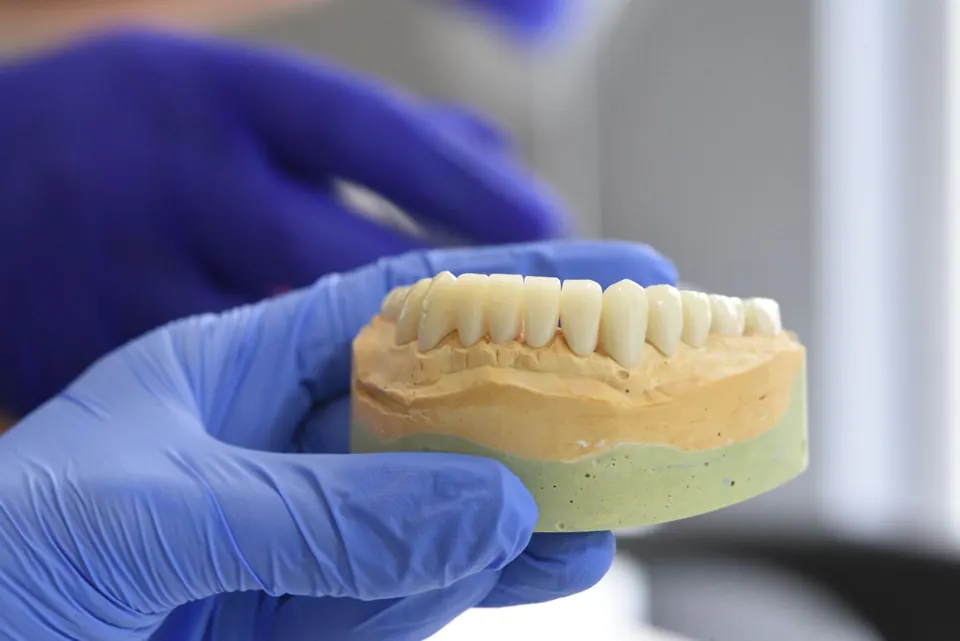
- Recementing: if the tooth is healthy with no decay, and the crown is intact and fits well, both are cleaned and the crown is cemented back. This is the simplest situation.
- Treatment then recementing: a small area of decay is treated and the tooth rebuilt, provided the crown still fits properly.
- A new crown: if the crown is damaged, fits poorly or looks unattractive, or if the tooth has needed significant rebuilding, a new dental crown is made, with a temporary one in the meantime. Digital impressions and in-house fabrication can, depending on the case, reduce the number of appointments.
- Rebuilding or retreatment: on a fractured or reinfected root-treated tooth, a new artificial core, or even root canal retreatment, may be needed before the crown.
- Extraction: when the root is split or the fracture extends too far below the gum, the tooth can no longer be saved. Replacing it with an implant or a bridge is then discussed.
That is why it helps to bring the crown to your appointment, even if it looks damaged.
Crown come off: is it an emergency?
A crown that has fallen out is rarely a serious emergency, but it is a relative urgency: it is best to be seen within the next few days. An exposed tooth becomes weaker, can decay or break, and the neighbouring or opposing teeth can shift slightly within a few weeks, to the point where the crown no longer fits.
The situation becomes more pressing if:
- the exposed tooth is very painful or very sensitive;
- swelling of the gum or cheek appears;
- the tooth is broken with sharp edges that cut your tongue;
- it is a front tooth and you have an important work or family commitment coming up;
- you think you may have inhaled the crown.
In these cases, call the practice without delay; our dental emergency in Rabat page explains what to do.
Preventing loose crowns and having yours checked in Agdal
A few habits protect the crown and the tooth that carries it:
- carefully brush the junction between crown and gum twice a day with a fluoride toothpaste;
- clean between your teeth every day with floss or interdental brushes;
- avoid biting hard objects (ice cubes, fruit stones, pens);
- if you clench or grind, ask whether a night guard is advisable;
- do not skip check-ups: an X-ray can reveal decay under a crown long before it makes the crown fall off.
At German Dental Clinic in Agdal, a crown that is loose or has come off is examined with a digital X-ray to understand the cause before choosing between recementing and a new crown. If you are in Rabat, keep your crown and book an appointment as soon as possible.
Frequently asked questions
Can I glue a crown back on myself?
Do not use superglue or household adhesive: these products are not designed for the mouth, stop the crown from seating exactly and make it difficult, sometimes impossible, to clean at the practice. A temporary cement from the pharmacy can help briefly if your dentist advises it, but the crown must then be checked and recemented professionally, after the tooth underneath has been examined.
How long can I go without my crown?
As short a time as possible, ideally just a few days. A prepared tooth left unprotected is more sensitive, decays more easily and can fracture. The neighbouring and opposing teeth can also shift slightly, to the point where the crown no longer fits properly and has to be remade. If you cannot be seen quickly, say so: temporary protection can be offered.
My crown is loose but has not fallen out: is it serious?
It is not an immediate emergency, but do not wait for it to fall out. On a natural tooth, movement often means the cement has dissolved, letting saliva and bacteria in and encouraging decay under the crown. On an implant, it is often a loose screw, which can be damaged if it keeps working. A prompt examination limits the damage.
Can the dentist reuse my crown that came off?
Often yes, if the crown is intact, still fits well and the tooth underneath is healthy. It is then cleaned and recemented. If it is cracked or distorted, or if the tooth has needed rebuilding, a new crown is usually required. Bring it in any case: even damaged, it helps work out what happened.
Why does my crown hurt when I chew?
The most common causes are a crown that is slightly too high, inflammation or infection of the tooth under the crown, decay at its edge, or a crack in the root. Mild discomfort for a few days after fitting is common, but pain that persists or increases should be examined, with an X-ray, to find its origin.
The information on this page is general. Only a consultation allows a diagnosis and a suitable treatment plan.