
Knocked baby tooth: the right first steps
After a knock to a baby tooth, stay calm, check your child's general condition first, rinse the mouth gently and press a clean gauze on the gum if it is bleeding. Never put a baby tooth that has come out back in. See a dentist the same day if the tooth has come out, been pushed in, moved, broken, or if the bleeding will not stop; for a simple bump with no displacement, an examination within the following days is usually enough.
Injuries to baby teeth are common, especially between 1 and 3 years of age, when children are learning to walk and often fall forwards. The upper front teeth are by far the most affected.
Before worrying about the tooth, make sure the head has not been injured. Some signs mean you should call a doctor or go to a general emergency department first:
- any loss of consciousness, even brief;
- vomiting, unusual drowsiness or abnormal behaviour;
- bleeding from the nose or ear;
- a deep cut to the lip or chin.
Then look for the tooth or fragment, and note the time and circumstances of the accident: this information will help the dentist.
Why a baby tooth is never put back
For a knocked-out adult tooth, every minute counts and putting it back is the right move, as our article on broken or cracked teeth explains. For a baby tooth it is the opposite, and the guidelines of the International Association of Dental Traumatology (IADT) are clear on this point.
The reason is anatomical: the root of a baby incisor sits right in front of the developing adult incisor inside the bone. Putting the tooth back risks pushing its root against that tooth bud, damaging it or carrying infection to it. The benefit, meanwhile, would be small for a tooth that will fall out a few years later anyway.
Keep the tooth all the same and bring it to the appointment. The dentist checks that it is complete: if a piece is missing, part of the root may still be in the gum.
If you cannot find the tooth, do not assume too quickly that it fell out. It may have been pushed entirely into the gum, to the point of seeming absent. An X-ray will confirm this. If your child coughs, chokes or has trouble breathing after the accident, the tooth may have been inhaled: that is a medical emergency.
Loose, displaced or broken: the different types of injury
The dentist identifies the type of injury, as treatment depends on it:
- concussion: the tooth is tender but not loose;
- subluxation: the tooth is slightly loose and the gum bleeds at the neck of the tooth;
- lateral luxation: the tooth is displaced, often with the crown pushed towards the palate, and may stop the mouth closing properly;
- extrusion: the tooth has partly come out of its socket and looks longer;
- intrusion: the tooth has been pushed into the bone and looks shorter, or even missing;
- avulsion: the tooth has come out completely;
- fracture: part of the crown has broken off; a pink or red dot in the centre means the nerve is exposed.
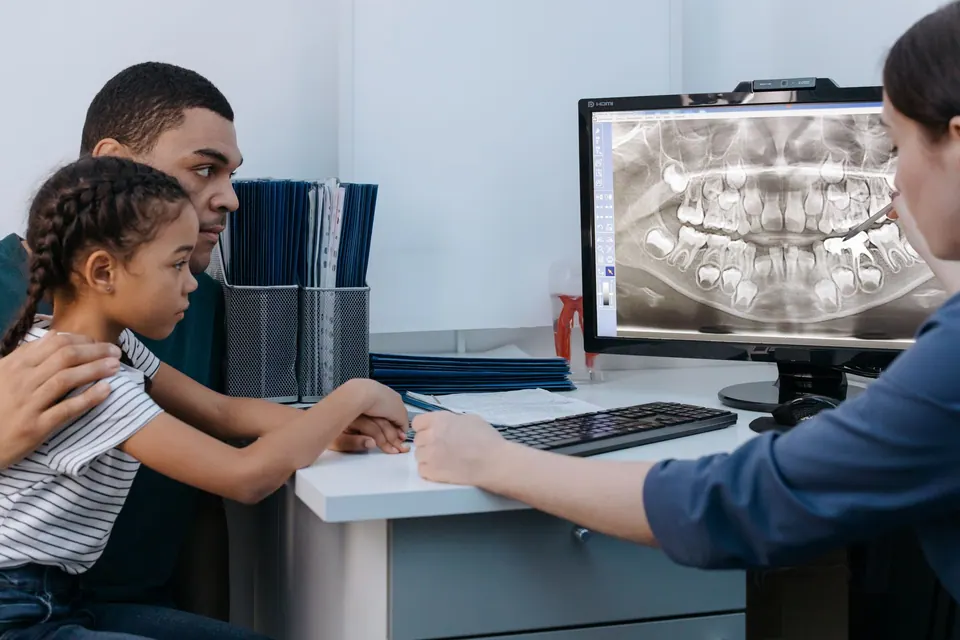
An X-ray is often useful to see the root, any fractures and, above all, the position of the tooth in relation to the developing adult tooth.
In young children, treatments are deliberately simple and minimally invasive. Many injuries are managed with monitoring and a soft diet alone. A displaced tooth that interferes with the bite may be gently repositioned or removed, a tooth that has come well out is usually extracted, a small chip is smoothed or repaired, and an exposed nerve leads to nerve treatment or extraction depending on age and extent.
The pushed-in tooth: often, we wait for it to come back down
Intrusion alarms parents: the tooth seems to have shrunk or disappeared into the gum. Yet in many cases the baby tooth re-erupts on its own over a few weeks to a few months, and the usual approach is to give it that time.
The X-ray guides the decision. When the root tip has been pushed towards the lip, away from the tooth bud, the tooth is monitored. When it has been pushed towards the developing adult tooth, extraction may be discussed to protect it.
During this waiting period:
- clean the area gently with a very soft toothbrush after every meal;
- an antiseptic can be applied with a cotton bud if the dentist recommends it;
- offer soft food for the first few days;
- attend the planned check-ups, even if everything seems fine.
Come back sooner if the gum swells, a small pimple appears above the tooth, your child develops a fever or pain returns after a few calm days. These signs suggest an infection that should not wait.
A tooth that has turned grey: should you worry?
A few days or weeks after a knock, it is common for a baby tooth to change colour. A grey, pinkish or brownish shade often reflects bleeding inside the tooth, a little like a bruise. Three outcomes are possible:
- the colour gradually lightens over a few months;
- the tooth stays grey, with no pain or sign of infection, until it falls out;
- the tooth darkens and signs of infection appear.
A grey tooth is therefore not, on its own, a reason to treat it. The dentist monitors the tooth and gum, with an X-ray if necessary. Treatment becomes worthwhile if there is a sinus tract (a small pimple on the gum), swelling, pain, increasing looseness or signs of infection at the root tip on the X-ray: the options are then cleaning the nerve or extraction. To recognise the signs of an abscess, see our article on dental abscesses.
A tooth that turns yellow and opaque points to a different reaction: the nerve protects itself by laying down dentine inside the tooth. This is generally harmless and simply needs monitoring.
Possible effects on the adult tooth
The adult tooth forms just behind the root of the baby tooth. A violent knock, especially an intrusion or avulsion in a very young child, can affect it while it is developing. Possible consequences include:
- a white or yellow-brown spot, or a small enamel defect, on the adult incisor;
- a malformation of the crown or root;
- delayed eruption or an adult tooth that comes through out of position.
These effects cannot be predicted at the time of the accident. They only become visible when the adult tooth erupts, often around 6 to 8 years of age for the incisors. There is no point in feeling guilty: most knocks to baby teeth have no effect at all on the tooth that follows, but follow-up allows anything that needs attention to be spotted early.
That is why the dentist schedules several check-ups in the weeks and months after the injury, sometimes until the adult tooth has come through. If it shows a spot or defect, solutions exist later on, adapted to the child's age.
The following days, and when to seek urgent care in Rabat
At home, a few measures help healing: soft food for a few days, gentle but regular brushing of the area, pain relief suited to your child's weight if needed, and limited use of a dummy or bottle if the dentist advises it.
See a dentist the same day if:
- the tooth has come out, or cannot be found;
- it has been pushed in, moved, or stops your child closing their mouth;
- it is broken with a visible pink or red dot;
- the bleeding does not stop after several minutes of pressure;
- swelling, fever or a pimple on the gum appear in the following days.
At German Dental Clinic in Agdal, children are seen from their very first teeth as part of our children's dentistry care, with digital X-rays when useful. After a knock, call the practice on +212 5 37 67 43 48 for guidance, or see our emergency dentist in Rabat page. For a check after an older injury or a tooth that has turned grey, you can book an appointment.
Frequently asked questions
My 2-year-old fell and the tooth is slightly loose: is it serious?
A tooth that is slightly loose but not displaced usually corresponds to a subluxation, which generally settles on its own within a few weeks. Offer soft food, brush gently and have the tooth examined in the following days. Come in sooner if it is displaced, interferes with closing the mouth or if the gum swells.
The baby tooth came out after the fall: should I keep it?
Yes, keep it in a clean tissue and bring it to the appointment, but never put it back in the mouth. The dentist checks that it is complete, as a fragment of root can stay in the gum. They also examine the gum, the neighbouring teeth and the position of the developing adult tooth.
How long does a pushed-in baby tooth take to come back down?
It varies with the child and the depth of the intrusion: re-eruption is often seen over several weeks, sometimes a few months. During this time, regular check-ups confirm progress and rule out infection. If the tooth does not move or signs of infection appear, the dentist reviews the approach with you.
My child's tooth has turned grey: does it need root canal treatment?
Not necessarily. A grey tooth after a knock often reflects internal bleeding, and it can lighten or stay grey without any problem. Treatment is only suggested if signs of infection appear: a pimple on the gum, swelling, pain or an abnormal X-ray. Regular monitoring is enough in other cases.
Is an X-ray needed after a knock to a baby tooth?
It is often useful, particularly if the tooth is displaced, pushed in, missing or broken. The X-ray shows the root, any fracture and the position of the tooth relative to the developing adult tooth, which guides the decision. For a simple bump without displacement, the dentist may do without it and suggest monitoring.
The information on this page is general. Only a consultation allows a diagnosis and a suitable treatment plan.
A question about your own situation?
Dr Fenjero Walid sees patients in Agdal, Rabat, for an assessment and answers that fit your case.