The short answer: a first check-up around age 6 or 7
The most widely cited recommendation, from the American Association of Orthodontists (AAO) among others, is to have a child's bite examined no later than about age 7. At that point the first permanent molars and incisors are coming through, so the dentist can already judge the space available, the balance between the jaws and any habits that might push growth off course.
A first check-up does not mean a brace. Most of the time it simply leads to monitoring, with further checks as the teeth come in. Its value lies in spotting, in good time, the situations where acting during growth is simpler, shorter or more effective than waiting for adolescence.
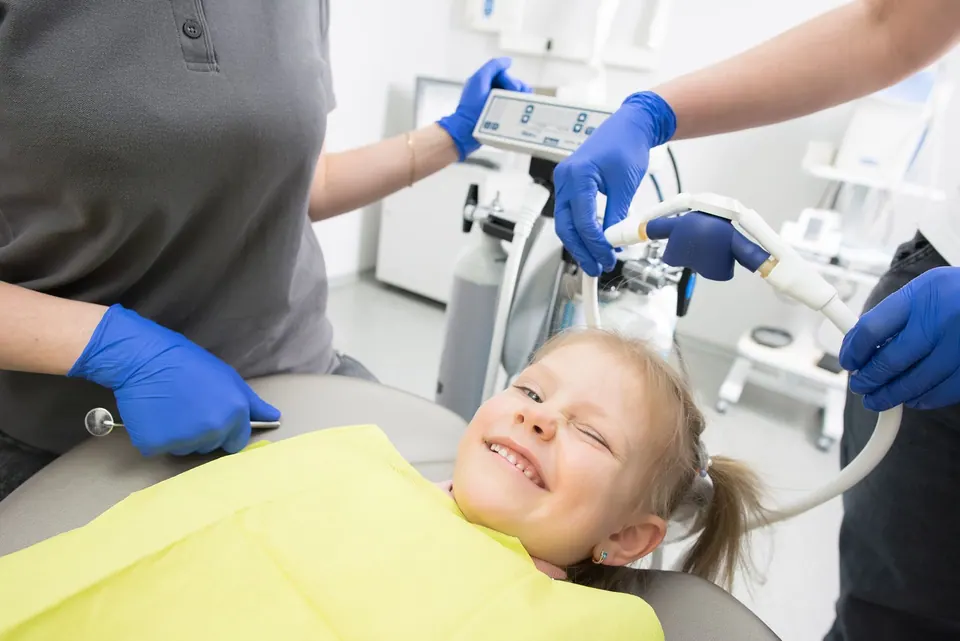
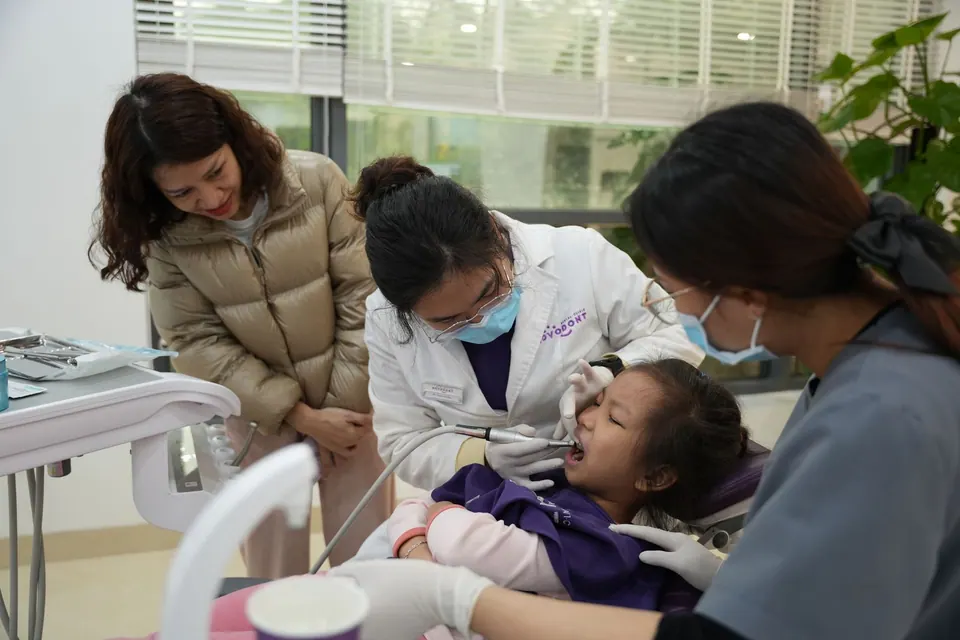
The assessment can take place during a routine visit to a children's dentist, who refers to an orthodontist if specific treatment is needed. If your child has never been to the dentist before, our article on the first dental visit will help you prepare.
Why this age: what a mixed dentition reveals
Between roughly 6 and 12, a child's mouth holds both baby teeth and permanent teeth. This is the mixed dentition, and it tells the clinician a great deal.
- The six-year molars have just erupted behind the baby teeth. The way the upper and lower ones meet gives a first idea of how the two jaws relate.
- The permanent incisors are arriving at the front. Their position shows whether space is short or an unusual gap is persisting.
- Growth is still under way. In the upper jaw, the suture between the two halves of the palate has not yet fused in a young child, which makes some widening corrections more accessible than in adults.
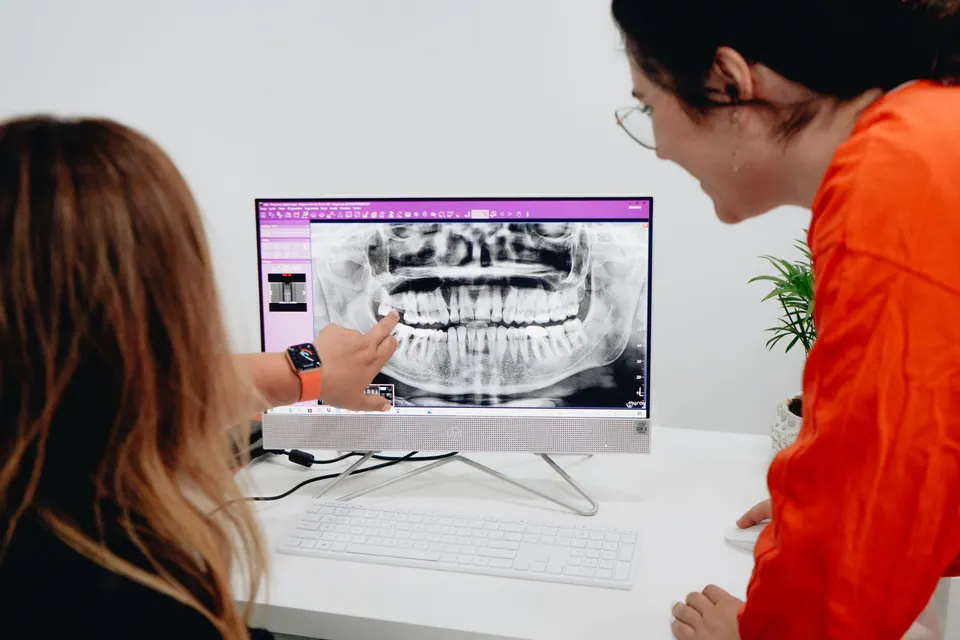
- The buds of future teeth have already formed in the bone. A panoramic X-ray, when justified, can confirm that no tooth is congenitally missing, that there is no extra tooth and that the canines are following a normal path.
Waiting until all the permanent teeth are in, around 12, remains appropriate for many simple alignment problems. For discrepancies linked to jaw growth, though, that wait can mean missing a useful window.
Signs that justify an earlier visit
Some signs are worth a professional opinion before age 7, sometimes as early as 4 or 5, especially if they persist:
- a crossbite: when the mouth closes, some upper teeth sit inside the lower ones, on one side or at the front, and the chin may shift sideways;
- lower front teeth in front of the upper ones, which can point to a growth discrepancy between the jaws;
- very protruding upper incisors, more likely to be damaged in falls and play;
- an open bite: the front teeth do not meet when the child bites together, often linked to a dummy or thumb;
- mouth breathing, lips apart at rest, snoring: these also concern the paediatrician or ENT specialist, since enlarged adenoids or tonsils can be involved;
- thumb or dummy sucking that continues after starting primary school;
- the tongue pushing between the teeth when swallowing or speaking, sometimes with a lisp;
- marked crowding of permanent incisors erupting without room;
- a baby tooth lost very early (decay, a knock), or a permanent tooth coming in while the baby tooth is still there;
- asymmetry of the face or smile.
None of these signs automatically means a brace. They simply show that an examination is useful to tell a passing variation from a problem that is settling in.
Interceptive treatment: correcting early what needs correcting
When treatment is proposed for a young child, it is called interceptive orthodontics or early treatment. The aim is not a perfect alignment but to correct a problem that would worsen with growth, or to guide the arrival of the permanent teeth. It is usually short, followed by a period of monitoring, and a second phase may still be needed in the teenage years.
The tools depend on the problem. German Dental Clinic offers clear aligners; the other devices below are options an orthodontist may propose depending on the case:
- a palatal expander, fixed to upper teeth, to widen a narrow upper jaw and correct a crossbite;
- a space maintainer, after the early loss of a baby tooth, to stop neighbouring teeth from closing the gap;
- removable plates or functional appliances, which steer growth in some jaw discrepancies;
- targeted extraction of certain baby teeth, to help a misdirected permanent tooth erupt, notably a canine;
- functional re-education (breathing, swallowing, tongue posture), often with a speech therapist;
- aligners designed for the mixed dentition, which exist for some cases, provided the child actually wears them.
Not every early treatment is useful. Current evidence mainly supports early intervention for crossbites with a jaw shift, very protruding incisors at risk of injury and certain harmful habits. For simple crowding, waiting until the end of the mixed dentition is often reasonable.
Common misconceptions and the parents' role
A few widespread beliefs sometimes delay a useful visit, or cause needless worry:
- “It's too early for a brace.” A check-up is not a brace: it is how you decide whether to act now, later or not at all.
- “The teeth will sort themselves out.” Sometimes true, for instance a slight gap between the upper incisors, which is common before the canines arrive. It is not true of a crossbite, which tends to persist and can steer growth the wrong way.
- “Baby teeth don't matter.” They hold the space for the permanent teeth. Untreated decay that ends in early extraction can lead to lost space and later crowding.
- “A brace can be decided from a photo.” Diagnosis relies on an examination, the real bite and, where needed, an X-ray.
At home, you can watch your child asleep (open mouth, snoring), support them in giving up the dummy or thumb without making them feel guilty, and protect their baby teeth with daily brushing using a fluoride toothpaste suited to their age. If their incisors stick out a lot, a mouthguard for contact sports is worth discussing with the dentist.
Your child's first orthodontic check-up in Agdal
German Dental Clinic sees children from their very first teeth. During the check-up, the dentist examines your child's teeth, bite, gums and habits, and asks you about breathing, sleep and any sucking habits. A panoramic X-ray is only taken if it adds useful diagnostic information. A digital impression with the intraoral scanner, without impression paste, is often better accepted by children than conventional impressions.
After the examination there are three possible outcomes: nothing to do for now, with checks as your child grows; aligner treatment if your child has a suitable indication; or referral to an orthodontist when an expander, a functional appliance or more complex care is needed. Adult treatment follows different constraints, which we cover in our article on braces and aligners for adults.
If you live in Rabat and your child is approaching 6 or 7, you are welcome to book an appointment for a first screening.
Frequently asked questions
My 4-year-old's front teeth don't meet: should I be worried?
This open bite is often linked to a dummy or thumb sucking. When the habit stops before the permanent incisors arrive, it frequently closes on its own. If it persists after the sucking has stopped, or if the tongue constantly sits between the teeth, an examination will show whether re-education or treatment would help.
Does early treatment avoid a brace in adolescence?
Not always. Interceptive treatment corrects a specific problem, such as a narrow palate or a misdirected tooth, and often makes what follows simpler. The final alignment of the permanent teeth may still need a second phase in the teenage years. The dentist explains from the start what the first phase can fix, and what it will not.
Can children wear clear aligners?
Aligners designed for the mixed dentition exist and can suit some alignment or spacing problems. They need to be worn almost constantly, which calls for a motivated child and attentive parents. For a significant jaw discrepancy or a very narrow palate, other appliances generally remain more appropriate. The choice is made after an examination.
Is an X-ray needed at the first check-up?
Not routinely. A panoramic X-ray is requested when it could change the decision: a suspected missing or extra tooth, a canine that is not coming down normally, delayed eruption. Doses with digital radiography are low, and the principle remains to take only the images that are genuinely useful for the child.
Can a general dentist carry out this screening?
Yes, screening for bite problems is part of a child's routine dental care. The dentist picks up warning signs, treats decay that threatens the space for permanent teeth and refers to an orthodontist when a specific appliance is needed. What matters is that this assessment happens early enough, without waiting for every tooth to come through.
The information on this page is general. Only a consultation allows a diagnosis and a suitable treatment plan.
A question about your own situation?
Dr Fenjero Walid sees patients in Agdal, Rabat, for an assessment and answers that fit your case.